BY: Isaac Amoah
The Ghana Agricultural and Rural Development Journalists Association (GARDJA), led by Richmond Frimpong, has officially unveiled an aggressive 6-month campaign dubbed “Save Our Sea (SOS)” with funding from Earth Journalism Network Funds.The campaign aimed at tackling illegal fishing and promoting marine conservation in Ghana over a 6-month period.Speaking at a day’s specialised training for members on effective media coverage on marine issues in Ghana, Richmond Frimpong explained that the Save Our Sea (SOS) Campaign is a coordinated national media intervention designed to expose, challenge and ultimately help reduce illegal fishing practices, including saiko, bottom trawling, light fishing and the use of destructive fishing gear, which continue to threaten Ghana’s marine ecosystem and coastal livelihoods.

Richmond Frimpong,GARDJA President with the support of Mr Kofi Adu Domfeh,GJA Chairman,Spio Garbarah and Mr Charles Smith, Ghana Country Coordinator, Earth Journalism Network (EJN) performing the official launching


The GARDJA president said that the funding from the Earth Journalism Network will strengthen the role of journalism as a tool for environmental accountability, public education, and policy influence in the fisheries sector.
He revealed that as part of the campaign, GARDJA will implement a range of activities, including capacity building for journalists: Specialised training workshops will be organised to equip journalists with knowledge in marine ecology, fisheries laws, investigative reporting techniques, environmental data analysis, and safety at sea.


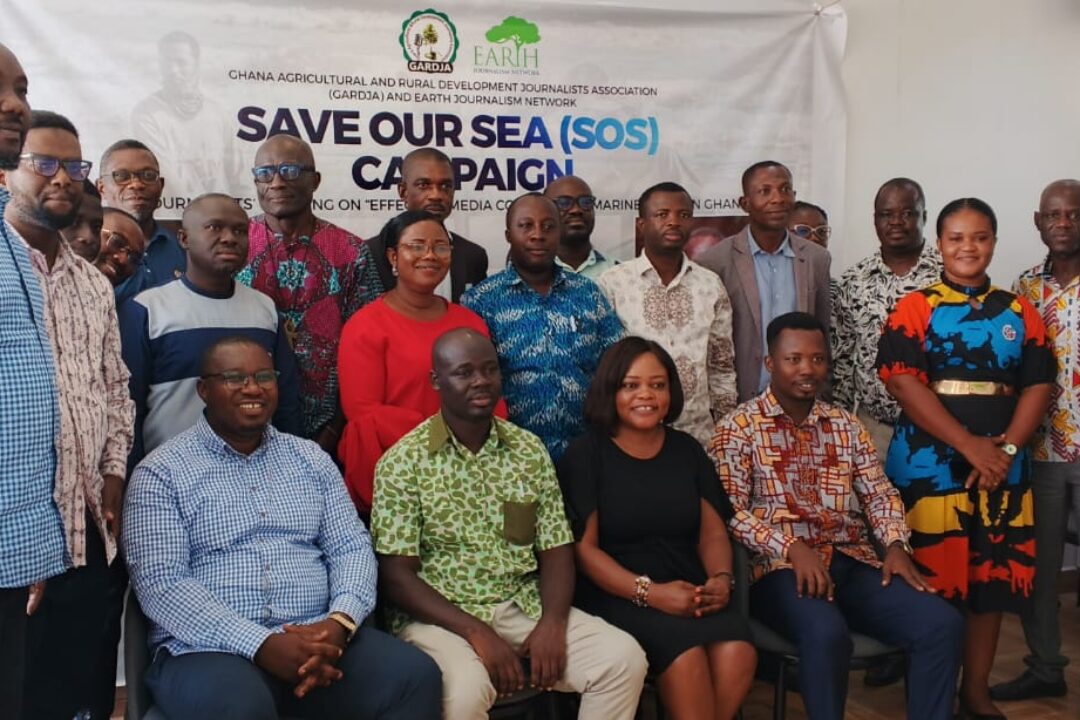
Participants in a group photograph
This, GARDJA’s president believes, will build a sustainable pool of journalists with expertise in marine and fisheries governance.Besides, GARDJA also will create a Marine Reporters Forum (MRF), a dedicated network of journalists from print, radio, television, and digital platforms committed to sustained, evidence-based reporting on marine and coastal issues. “The Forum will facilitate collaboration, story sharing, and peer learning and will be managed by GARDJA beyond the lifespan of the project.”
On investigative and data-driven journalism, Richmond Frimpong said GARDJA members will undertake in-depth investigations into illegal fishing operations, including industrial trawler incursions into the Inshore Exclusion Zone and weaknesses in enforcement systems. Using satellite tracking tools, vessel monitoring systems, and community informant networks, the campaign will produce documentaries, radio discussions, podcasts, photo essays, social media content, and infographics. Stories will be published across major media platforms.Adding GARDJA will also issue a call for proposals, with selected journalists receiving bursary support to produce high-impact investigative stories.Touching on community reporting tours and dialogues, GARDJA’s president said Journalists will visit key coastal communities, including Elmina, Axim, Shama, Keta, Ada, Winneba, and James Town, to document the experiences of artisanal fishers, women fish processors, youth and traditional authorities. These engagements will culminate in community forums to amplify local voices and foster dialogue.Policy Engagement and Accountability Journalism:The project will convene stakeholder engagements involving journalists, civil society organisations, coastal communities, and relevant institutions to ensure evidence from investigations informs policy decisions, enforcement actions, and legislative reforms.Advancing Marine Conservation GoalsThe SOS campaign aligns with national and global marine conservation priorities, including Ghana’s commitment to the 30×30 Marine Conservation Target, which seeks to protect 30 per cent of marine and coastal areas by 2030.
By exposing illegal practices and strengthening public accountability, the project will contribute to improved governance, transparency, and sustainable fisheries management.According to him, primary beneficiaries include journalists, artisanal fishers, canoe owners, women fish processors, and coastal youth whose livelihoods depend on healthy marine ecosystems. Secondary beneficiaries include policymakers, government officials, and legislators who require credible, independent evidence to inform reforms.Mr Frimpong expressed appreciation to Earth Journalism Network for the funding support, describing it as a critical investment in journalism-driven environmental protection and sustainable development.
About GARDJA
The Ghana Agricultural and Rural Development Journalists Association (GARDJA) is a professional network of journalists who report on issues of agriculture, environment, and rural development.Established in 2014, GARDJA is a member of the International Federation of Agricultural Journalists, the world’s largest association of agricultural communication practitioners, with membership covering more than 60 countries.
The organisation works to increase the quantity and quality of agriculture — and environment-focused reporting in the media by providing training, bursary support, research capacity, networking opportunities, and related support for journalists and organisations. GARDJA also works to influence policymakers for improved environmental policies and programmes to support Ghana’s efforts towards meeting the Sustainable Development Goals (SDGs). Mr Charles Smith, Ghana Country Coordinator, Earth Journalism Network (EJN), took participants through “Telling Compelling Marine Stories: How can journalists tell compelling stories that pressure authorities to protect marine resources? What satellite data, remote sensing, AI, investigative, and data journalism tools can journalists use?
On his part, Kofi Adu Domfeh, GJA Chairman, Ashanti region, also made a presentation on “Advocacy Journalism: How can journalists tell stories that drive policy change?” What lessons from galamsey reporting can be applied to the SOS project?Mr Kingsley E. Hope, the former Ashanti Regional GJA chairman, who doubles as the Ashanti Regional correspondent for Ghanaian Times, made a presentation on the topic “Ethical reporting techniques”.The official launch of the Marine Reporters Forum and the next steps in the Save Our Seas (SOS) project were done byGARDJA President & Ghana Country Coordinator, EJN