The Forestry Commission (FC) has partnered with the Africa Forest Forum (AFF) and the Alliance for a Green Revolution (AGRA) in Africa to host a national policy dialogue in Accra. Dubbed “Deforestation-Free Green Value Chains in Ghana: Policy Pathways for Youth Employment and Sustainable Land Management,” the event focused on strengthening Ghana’s readiness for the European Union Deforestation Regulation (EUDR).
This regulation requires essential export commodities, such as cocoa and cashew, to be fully traceable to ensure they do not originate from deforested land.


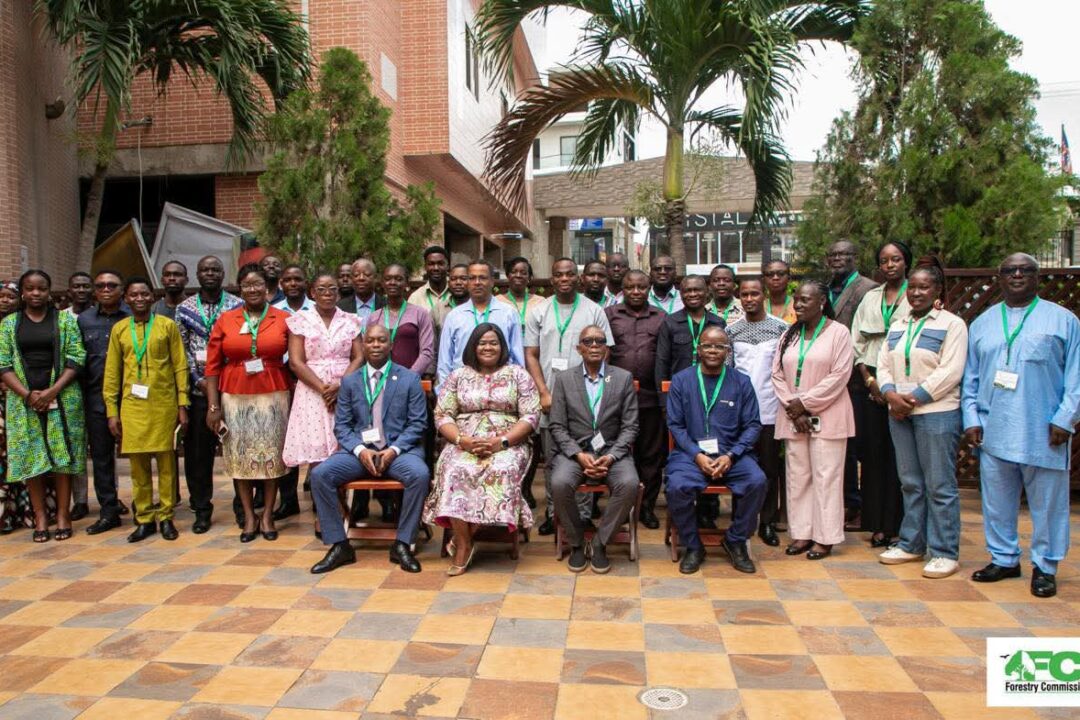
participants in a group photograph
During the event, Professor Labode Popoola, the Executive Secretary of the African Forest Forum, explained that the regulation aims to discourage destructive farming practices while promoting production systems where agriculture and forest conservation can thrive together.
He noted that the implementation deadlines are set for June 2026 for small operators and December 2026 for large operators.
He emphasised that the dialogue provided stakeholders with a valuable opportunity to address challenges and collaborate on sustainable value chains, urging government agencies, development partners, industry leaders, and young entrepreneurs to work together inclusively.
Dr. Betty Simawa Annan, the Country Director for the Alliance for a Green Revolution in Africa, highlighted her organisation’s commitment to building a practical national roadmap, promoting youth-led traceability businesses, and empowering women and smallholder farmers.

She shared that her organization is proud to support the African Forest Forum through a grant that scales up youth-led climate innovations across Ghana, Kenya, and Ethiopia. This initiative aims to train 3000 young people and women in essential business skills, support over 30 youth-led enterprises, and help each participating country establish a national roadmap by the end of 2027.
Officially opening the programme, the Chief Executive of Forestry Commission, Dr.
Hugh Brown stated that the country is actively strengthening its institutions and traceability systems to ensure that exports meet international requirements. He stressed that Ghana’s forests are fundamental to national development because they protect water sources, regulate local climates, preserve biodiversity, and provide vital resources like timber, food, and fuelwood that support millions of livelihoods and long-term agricultural productivity, particularly in the cocoa sector.
Despite their importance, Dr. Brown noted that Ghana’s forests face severe threats from agricultural expansion, illegal mining, uncontrolled cattle grazing, unsustainable logging, wildfires, and infrastructural development. However, he pointed out that the nation has strong foundations to build upon, including the Ghana Forest Investment Program, the Ghana Cocoa Forest REDD+ Programme, and existing farm-mapping initiatives. He also highlighted that Ghana’s previous experience with the European Union under the Voluntary Partnership Agreement (VRA) offers valuable lessons in forest governance and legality assurance. He concluded by reaffirming the Forestry Commission’s ongoing commitment to collaborating with all stakeholders to achieve shared deforestation-free goals.
The dialogue featured several expert presentations to provide participants with deeper clarity. Mr. Kwabena Akyeampong Boakye Esq, Director for the Timber Validation
Department (TVD) presented on Ghana’s implementation progress and roadmap of the Forest Law Enforcement Governance and Trade (FLEGT). Dr. Richard Asare, the Country Representative for the International Institute of Tropical Agriculture (IITA), discussed policy pathways for transforming Ghanaian cocoa into a deforestation-free commodity. Dr. Tefera Belay, a project manager with the African Forest Forum, provided an overview of the youth-led climate innovations project and the objectives of the dialogue. Additionally, Ms. Leticia Yankey, an entrepreneur, spoke on business opportunities for youth in cocoa processing. The event successfully concluded with an engaging interactive session.Source:Forestry Commission