By:Isaac Amoah
The Blue Heart of Ghana


Ghana’s national identity is inextricably linked to the Atlantic Ocean. From the bustling shores of Keta to the vibrant landing beaches of Half Assini, along the country’s approximately 550-kilometre coastline, the ocean is not merely a natural resource; it is our lifeblood.
It provides food security for millions of people, sustains more than 14,000 fishing vessels and supports the livelihoods of a significant proportion of the population.
Professor Berchie Asiedu, Acting Deputy Executive Director (Technical) of the Fisheries Commission, a member of the National Blue Economy Strategy Technical Committee and the National Committee on Aquaculture, recently made these remarks in an interview recently.
He also disclosed that the Ministry of Fisheries and Aquaculture (MoFA) was developing legislative instruments to operationalise the Fisheries and Aquaculture Act, 2025 (Act 1146). The instruments are expected to introduce stiffer penalties for the destruction of marine habitats and grant the Fisheries Commission greater autonomy in enforcing its conservation mandates.

The professor acknowledged that Ghana’s marine environment faces unprecedented threats from three major sources: climate change, plastic pollution, and illegal, unreported and unregulated (IUU) fishing.
He stated, “Today, I stand before you to outline how the Ministry of Fisheries and Aquaculture (MoFA) and the Fisheries Commission are leading the charge to protect this heritage and meet the ambitious global 30×30 target.”
The 30×30 commitment
From vision to reality, Ghana has committed to the Kunming-Montreal Global Biodiversity Framework, adopted at the 15th meeting of the Conference of the Parties (COP15), held in Montreal, Canada, from December 7 to 19, 2022.


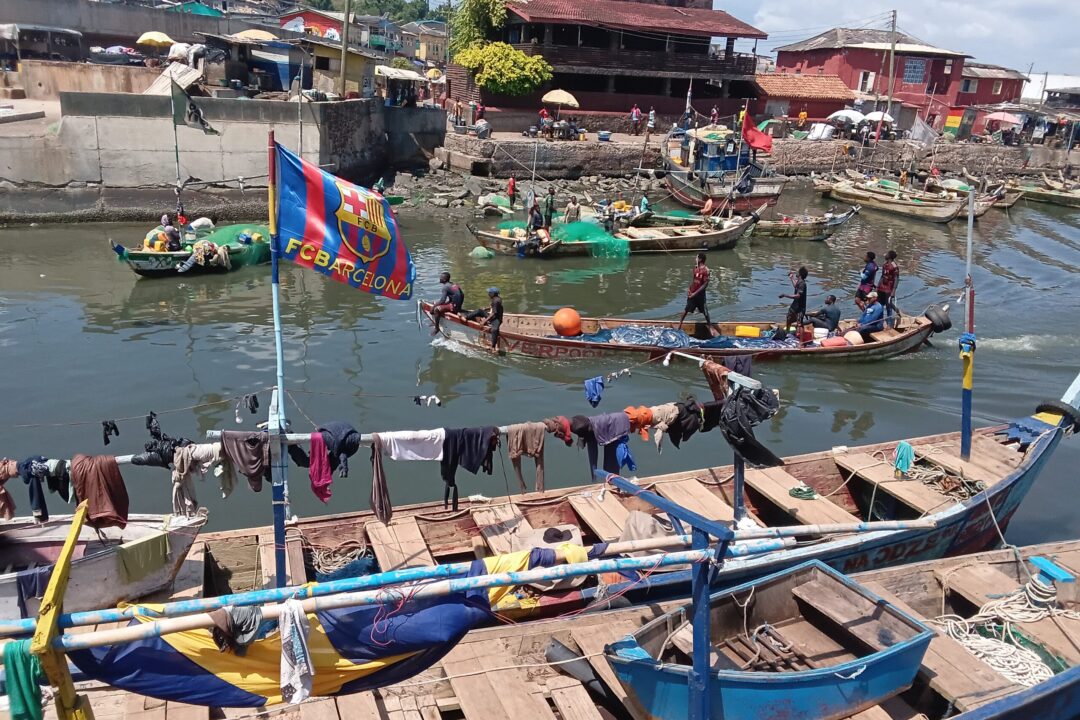
Some scenes from Elmina Fisheries Harbour area
The framework calls for the conservation and protection of at least 30 per cent of the world’s terrestrial and marine areas by 2030.
For a maritime nation like Ghana, this commitment is more than a pledge; it is a survival strategy.
A call on journalists to support Ghana’s 30×30 target
During the training programme, the Acting Chief Director called on journalists and media practitioners to support efforts towards achieving the 30×30 target.
“I call on our journalists and media practitioners to continue providing their technical support and on our coastal communities to remain our strongest allies. Protecting our marine environment is not a choice between ‘fish or no fish’; it is a choice between a legacy of abundance and one of empty nets,” he ststated.
Journalists support Ghana’s 30×30 target
In response to Professor Asiedu’s call, the leadership and members of the Ghana Agricultural and Rural Development Journalists Association (GARDJA) pledged to support the implementation of Ghana’s 30×30 target through a series of activities.
These include a recent visit to the Elmina Fisheries Harbour, where they interacted with stakeholders across the fishing value chain to assess the implementation of fisheries policies and gather first-hand information about the challenges confronting the sector.
Journalists intensify advocacy and awareness campaigns
The President of GARDJA, Richmond Frimpong, officially launched an ambitious six-month campaign dubbed “Save Our Sea (SOS),” with funding support from the Earth Journalism Network.
The campaign seeks to combat illegal fishing and promote marine conservation in Ghana.
Speaking at a specialised one-day training programme for members on effective media coverage of marine issues in Ghana in March 2026, Mr Frimpong explained that the SOS campaign was a coordinated national media intervention designed to expose, challenge and ultimately help reduce destructive fishing practices.
These include saiko, bottom trawling, light fishing and the use of destructive fishing gear, all of which continue to threaten Ghana’s marine ecosystem and the livelihoods of coastal communities.
The GARDJA president said the initiative was also aimed at strengthening the role of journalism as a tool for environmental accountability, public education and policy influence in the fisheries sector.


Activities being undertaken by GARDJA include capacity-building programmes for journalists, particularly specialised training workshops designed to equip participants with knowledge of marine ecology, fisheries laws, investigative reporting techniques, environmental data analysis and safety at sea.
Inclusion of marginalised groups
The tour, which took place on Thursday, November 12, 2026, at the Elmina Fisheries Harbour in the Komenda-Edina-Eguafo-Abrem (KEEA) Municipality of the Central Region, was intended to assess the implementation of fisheries policies and gather first-hand feedback from stakeholders across the fishing value chain.
Speaking to “The New Trust” newspaper after the successful tour, Mr Frimpong expressed satisfaction with the efforts being made by stakeholders across the fishing value chain, as well as the government, towards achieving the 30×30 target.
However, he stressed that there was still considerable room for improvement, given the persistent reports of illegal, unreported and unregulated (IUU) fishing activities.
According to him, the tour and stakeholder engagements formed part of GARDJA’s efforts to promote the inclusion of marginalised groups in the fishing value chain.
“This project is intentionally designed to ensure that marginalised groups, particularly women fish processors, coastal youth, indigenous fishing communities, ethnic minorities in fishing settlements and persons with disabilities, actively participate in and benefit from all activities,” he explained.
He further noted that IUU fishing did not affect all groups equally, with women and young people in coastal communities often bearing the greatest social and economic burdens.
“For this reason, GARDJA has embedded inclusion throughout the project’s implementation, from story selection to community engagement and capacity-building activities. The project also prioritises the voices of marginalised stakeholders in all its reporting,” Mr Frimpong said.
He added, “We, as journalists, have been conducting community listening sessions, and we are here in Elmina to engage specifically with women fish processors, young people involved in the fishing value chain, indigenous fishing families and persons with disabilities, whose access to livelihood opportunities is often further constrained by declining fish stocks.”
A call for sustained efforts by all stakeholders
Following the successful engagement with various stakeholders, Mr Frimpong called for renewed and sustained efforts to consolidate the gains made so far, particularly in protecting Ghana’s marine environment.
He emphasised the need for all stakeholders to remain committed to safeguarding the sea for present and future generations.
A call for special funds to support fishermen and fish processors
Mr Frimpong also appealed to the government to establish special funding schemes to support stakeholders across the fishing value chain, particularly fishermen and fish processors.
The GARDJA president observed that although fishermen, canoe owners and fish processors, among other stakeholders, believed that the annual closed season was yielding positive results through increased fish catches after the restriction period, the negative effects of the intervention on their livelihoods needed to be addressed through pragmatic support measures.
Education and compliance with annual closed seasons
He said the association also supported calls by chief fishermen, fishing captains and canoe owners for intensified public education and awareness creation ahead of the annual closed season.
He stressed the importance of ensuring that all stakeholders understood and complied with the restrictions to achieve the desired conservation outcomes.

Mr.Stephen Asempa
Fisheries Commission intensifies efforts to enhance fishing activities in KEEA Municipality
Mr Stephen Asempa, the Komenda-Edina-Eguafo-Abrem (KEEA) Municipal Director of the Fisheries Commission, has reaffirmed the commission’s commitment to ensuring that fishing activities are conducted in an orderly and sustainable manner in the municipality.
He gave the assurance in an exclusive interview following a tour of the Elmina Fisheries Harbour.
Key challenges confronting the Fisheries Commission
Mr Asempa said the commission was facing several challenges, particularly with regard to illegal, unreported and unregulated (IUU) fishing.
He explained that the commission’s focus was on clamping down on IUU fishing, the use of chemicals in fishing, light fishing and other illegal fishing practices. He added that the use of unapproved fishing gear was also a form of IUU fishing.
He said the commission was leaving no stone unturned in its efforts to address these challenges.
Seizure of generators from fishermen
On the issue of light fishing, Mr Asempa said the commission sometimes seized generators from fishermen at landing beaches.
“When we see you going to fish with a generator, we’ll approach you, especially when you’re using two generators. You can’t say you’re using two generators just for the lighting system within one canoe. So, normally, when we see that, it implies you’re going to engage in light fishing. We’ll then monitor you closely. If we have to impose a sanction on you in that regard, we’ll do so,” he added.
The KEEA Municipal Director of the Fisheries Commission disclosed that during the just-ended closed season, his outfit seized two generators, although their owners claimed that the equipment was faulty and needed repairs.
He added that the commission was determined to eliminate light fishing and other forms of IUU fishing.
He admitted that light fishing remained a major challenge, particularly among fishing groups operating in the area. He explained that most fishing activities in the area revolved around light fishing, making it one of the commission’s major areas of concern.
“On a routine basis, we conduct patrols at the landing beaches to ensure that light fishing is avoided. For some time now, we’ve been going around the landing beaches to ensure that the lights they use are seized, especially during closed seasons,” he explained.
“We’re strongly against light fishing, and we (the Fisheries Commission) are working to ensure that fishers go fishing without using lights,” he added.
Empowering women and persons with disabilities (PWDs)
Mr Asempa said women were an important stakeholder group in the fishing industry and were therefore given attention in the commission’s activities.
He explained that women played a crucial role in the fisheries value chain, particularly in fish processing and marketing.
“If a fisherman brings fish and nobody comes around to buy it, it means the whole value chain ceases at that point. So, basically, we visit them (women fish processors and fish sellers) in their kitchens, motivate them and educate them on their activities,” he said.
Use of chemicals to preserve smoked fish
He pointed out that some fish processors resorted to using illegal substances, including chemicals, to preserve smoked fish and extend its shelf life.
He said his outfit frequently visited the processors and discouraged them from engaging in such practices.
Promotion of natural fish preservation methods
Mr Asempa revealed that, through continuous education and awareness creation, fish sellers and processors had begun adopting natural methods of preserving fish instead of using chemicals.
“So, it’s one of the things we do as the Fisheries Commission. We visit their kitchens to ensure that they adopt approved methods of preserving fish,” he added.
Safe Fish Certification Scheme
According to Mr Asempa, the commission currently operates a scheme known as the Safe Fish Certification Scheme, under which certificates are issued to qualified fish processors.
“We visit the kitchens of fish processors, inspect them and ensure that everything is in order. If everything meets the required hygiene standards, we issue you a certificate, which qualifies you as a certified fish processor. The certificate is endorsed by the Fisheries Commission,” he explained.
Involvement of PWDs in the fisheries value chain
He said persons with disabilities were encouraged to participate in the fisheries value chain, although their involvement depended largely on the nature of the activities, particularly fish processing.
“You will certainly come across some PWDs who can assist in fish processing,” he added.
However, he did not readily attest to whether persons with physical disabilities could safely participate in fishing expeditions at sea, given the risks involved.
Creating an enabling environment for PWDs
The KEEA Municipal Director of the Fisheries Commission said that during inspections and monitoring exercises at fish processors’ kitchens and facilities, the commission ensured that the facilities were accessible and friendly to persons with disabilities.
“Therefore, they can also operate from there because, at least, they must have a livelihood to depend on, especially since we find ourselves in a fishing community,” he added.
Ban on monofilament nets
According to Mr Asempa, one of the key components of the 2022–2026 Fisheries Management Plan is the ban on the use of monofilament nets.
He said the Fisheries Commission was continuing to enforce the ban.
“In fact, about two months ago, a fisherman who had gone on a fishing expedition unfortunately had an accident involving a tuna vessel, resulting in damage to his fishing gear. When we realised that he was using monofilament nets, he was sanctioned to serve as a deterrent to others,” he said.
Hands of God CEO calls for support for fish processors
The Chief Executive Officer (CEO) of Elmina-based Hands of God Fish Processing Company, Mrs Beauty Deku, has shared her experience in the fishing industry with “The New Trust” newspaper.
Mrs Deku, who has won the Best Municipal and Central Regional Fish Processor of the Year awards, said she had been in the business for 38 years and had also been nominated for a national award.
According to her, although fish processing is a very challenging undertaking, her commitment and determination have enabled her to remain in the business.


Mrs.Beauty Deku speaking in an interview
m
Fire outbreaks and loss of revenue
The CEO revealed that some of the challenges she had encountered over the years included fire outbreaks and loss of revenue, resulting from the use of illegal chemicals in fishing.
According to her, their experience in the business had enabled them to identify fish caught through illegal, unreported and unregulated (IUU) fishing practices.
She explained that fish caught using chemicals and other illegal methods could usually be identified by their colour during processing, a situation that had resulted in financial losses over the years.
“This is because when such fish are detected after we have bought them from the fishermen, they have to be discarded because we cannot give contaminated fish to our customers. Moreover, we also consume the same fish,” she said.
Appeal to government for special support
Mrs Deku, therefore, appealed to the government to provide fish processors with equipment for detecting fish caught illegally using chemicals.
Looking forward to the Women’s Bank
Mrs Deku said fish processors also needed financial support to expand their businesses.
“We are waiting for the Women’s Bank to provide loans at low interest rates to enable us to expand our businesses,” she said.
According to her, although some banks continued to offer them loans at interest rates ranging from 19 to 20 per cent, she was hopeful that the Women’s Bank would be a game-changer for fish processors.
Educating fishermen
The CEO of Hands of God Fish Processing Company pointed out that continuous education of fishermen had contributed to a reduction in the use of illegal chemicals in fishing.
She said that, as a result, she had not recorded any losses this year, unlike in previous years.
Preference for traditional fish-smoking methods over Ahoto ovens
She revealed that although the government had supplied Ahoto ovens in the past to facilitate fish processing and drying, the ovens slowed down the process.
Consequently, they continued to rely more on the traditional firewood method, with proper control of smoke.
According to her, appropriate measures must be put in place to prevent smoke from polluting the environment and contaminating the fish.
She added that their workers always wore nose masks to protect their health.
More than 10,000 pounds of fish sold this year
Mrs Deku disclosed that she had sold more than 10,000 pounds of fish this year alone, adding that the fish currently undergoing drying and processing would be stored for sale next year.
“We have had to suspend the sale of fish this year because the prices being offered are not encouraging,” she said.
100 people employed
Mrs Deku revealed that her company had currently employed 100 workers, in addition to casual labourers.
“The fish processing sector holds the key to addressing unemployment in Ghana,” she said.
The fish processing expert strongly believes that the sector, if given the necessary support, could help reduce unemployment, particularly among women.
She, however, expressed concern that some young men and women were unwilling to work hard and preferred easier ways of making money.
“As far as I am concerned, anyone who says there are no jobs in Ghana does not want to make the necessary sacrifices or work hard to earn money. A number of young men and women come to work for a few days and then disappear,” she added.
She, therefore, encouraged Ghanaian youth to embrace hard work and remain committed to building a better future.
Meeting with Elmina fishermen
Speaking on behalf of the Elmina Fisheries Harbour Chief Fisherman, the Public Relations Officer (PRO), Ebusua Panin Kwesi Tawiah, together with other key members of the group, including Mr Isaac Armah, Captain of Fisheries Vessel; Mr Paa Kwasi Eshun; Mr John Tawiah; Mr Charles Tawiah, Chairman; and Mr Kofi Boateng, a canoe owner and fisherman, commended the Ghana Agricultural and Rural Development Journalists Association (GARDJA) for the visit.
They also encouraged the association to sustain its engagement with the media to help identify the challenges confronting their businesses and amplify their concerns to attract the necessary support.
Annual closed season yielding positive results
Ebusua Panin Kwesi Tawiah indicated that the annual closed season implemented by the government was yielding positive results.
According to him, although fishermen initially found it difficult to embrace the initiative, they had begun to appreciate its benefits after two years of implementation.
“Since its inception, it has been very difficult for us to embrace it. However, after two years of implementation, we have seen a difference between last year and this year. Many fishermen have been recording higher catches. The closed season initiative has also contributed to increased fish catches,” he said.
The PRO to the Elmina Fisheries Harbour Chief Fisherman revealed that although fishermen were initially hesitant about the initiative, they had now witnessed improvements in their catches.
Call for early and adequate public education
He, therefore, called for early and adequate education and awareness creation among stakeholders across the fisheries value chain to ensure compliance with the closed season initiative.
He added that canoe owners should also be educated on the importance of the closed season to encourage them to comply with the directive.
Appeal for support for canoe owners

Ebusua Akwasi Tawiah and his team
Ebusua Akwasi Tawiah also appealed to the government to support canoe owners to enable them to acquire equipment for their businesses at affordable rates.
According to him, although the government usually supports fishermen with outboard motors, the high costs of maintenance and fuel, coupled with taxes, were pushing some of them out of business.
Use of monofilament nets by fishermen
The PRO disclosed that, as part of efforts to discourage the use of monofilament nets, they had held more than four meetings on the issue.
He, however, called for further education and awareness creation before the enforcement of the law banning their use.
Low fish prices affecting fishermen
Ebusua Akwasi Tawiah said the abundant fish catches had resulted in lower market prices, making it difficult for fishermen to recover the costs incurred in fuelling their vessels for fishing expeditions.
He also appealed to the government to intervene urgently to stop the use of chemicals in fishing.
The PRO to the Chief Fisherman admitted that, despite continuous education, some recalcitrant fishermen continued to use dynamite, DDT and other illegal chemicals in fishing, posing serious health risks to fish consumers.
“We are determined to help flush out these illegal fishing practices, and we need the full support of the government. We are calling on the government to procure and supply us with detection equipment to monitor activities at sea and those of fishermen. We are, therefore, patiently waiting for monitoring equipment to help flush out all forms of illegal, unreported and unregulated (IUU) fishing,” he said.