The Director-General of the Cyber Security Authority(CSA), Mr Divine Selase Agbeti, has reminded Ghanaians, especially media professionals, that national security is not the exclusive responsibility of the security agencies.
According to him, national security is a shared national duty. The media is not a spectator in that effort. It is a strategic partner. Adding that this partnership does not require the media to surrender its independence, suppress legitimate criticism, or become an extension of government.
Mr Agbeti explained that, on the contrary, a professional, independent, and courageous press strengthens national security by exposing wrongdoing, countering falsehoods, informing the public, and holding institutions accountable But freedom carries responsibility.


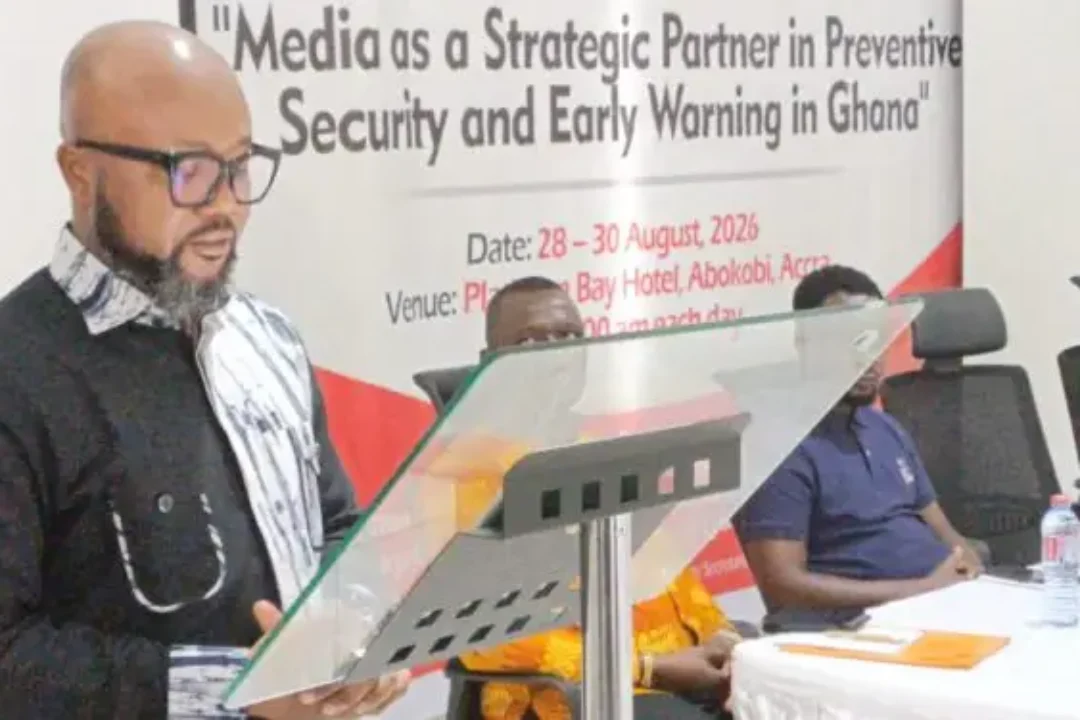
Mr Divine Selase Agbeti speaking at the event
He observed that in a volatile information environment, accuracy, context, and judgement are themselves instruments of national resilience. According to him, a misleading headline can spread across the country in minutes.
An unverified video can trigger fear, inflame communal tensions, or damage public confidence. A report that reveals sensitive operational details can compromise an investigation and put lives or critical systems at risk.Conversely, one carefully verified report can stop misinformation, protect the public, and help institutions respond effectively.

The difference often lies in the professional judgement exercised before publication. The digital environment has intensified this responsibility. Cybercriminals and hostile actors exploit urgency, fear, and public trust,” he added.

participants in a group photograph with officials
The Director General of CSA made the call at the closing ceremony of the two-day residential training workshop for members of PRINPAG held at ”Platinum Bay Hotel, Abokobi, Accra.The insightful workshop was on the theme “Media as a Strategic Partner in National Security” at Platinum Bay Hotel, Abokobi | Sunday, 30 August 2026.
He observed that over the past two days, “we have examined Ghana’s national security architecture, emerging and asymmetric threats, communal conflict, strategic communication, the legal framework governing security and intelligence, cybercrime, information warfare, ethics, press freedom and the national interest.”
According to him, these were not separate conversations. Together, they define the environment in which the Ghanaian media must now operate. The central message of this workshop is simple: national security is not the exclusive responsibility of the security agencies.
The Cyber Security Authority boss pointed out that when a journalist’s account is compromised, the attacker gains access not only to data but also to credibility and an audience.He therefore reminded journalists that cybersecurity must become part of editorial culture.
“Every newsroom should adopt basic safeguards: strong, unique passwords; multi-factor authentication; prompt software updates; secure backups; verification of links and attachments; clear access controls; and an incident response plan Sources and sensitive materials must be protected, and staff must know where and how to report cyber incidents.”
Mr Divine Selase Agbeti said these issues are no longer purely technical matters; they are questions of professional integrity and institutional survival.He therefore proposed the following five practical commitments arising from the workshop to media practitioners and media organisations: first, they should verify before amplifying.
According to him, speed matters in journalism, but accuracy matters more. Content relating to security incidents, communal conflict, or public emergencies should be independently verified, geolocated where possible, and checked against credible official and community sources.Secondly, journalists must protect security operations and people.
He said the public interest must guide reporting, but it must avoid disclosing tactical positions, identities of protected persons, sensitive investigative details, or information that could assist criminals and hostile actors.
Third, media organisations should build cyber-resilient newsrooms.
Mr Agbeti said PRINPAG members should designate cybersecurity focal persons, train staff regularly, protect official accounts, and maintain simple procedures for escalation, recovery, and public correction.
Fourth, correct misinformation visibly and quickly. Corrections should be given sufficient prominence to reach the same audiences exposed to the original error. Adding that responsible journalism is demonstrated not by never making a mistake but by responding transparently when one occurs. Fifth, media organisations should strengthen structured engagement.
He therefore gave assurance that the Cyber Security Authority will work with PRINPAG to promote regular briefings, awareness sessions, incident-reporting guidance, and practical exchanges between journalists and relevant security institutions.
The CSA boss believes that trust is built before a crisis, not during one.He therefore encouraged PRINPAG to translate the lessons from the workshop into a concise newsroom protocol on national security and cyber incident reporting.
Such a protocol, he said, should preserve editorial independence while establishing standards for verification, protection of sensitive information, source security, corrections, and liaison with the appropriate authorities.
Stressing that the true value of the workshop will be measured by what changes in their newsrooms after today.For security institutions, Mr Agbeti said partnership must be reciprocal.
He reminded security agencies that the media can not report responsibly when credible information is unnecessarily delayed or when communication is inconsistent. “Public institutions must communicate promptly, accurately, and respectfully. Classification must never serve as a convenient shield against accountability. When information can not be released, the reasons should be explained as far as the law and operational realities permit,” he added.
The Director-General of the Cyber Security Authority pointed out that Ghana’s security will increasingly depend on their ability to protect both physical and information spaces. He said the media helps citizens distinguish facts from manipulation, legitimate scrutiny from reckless speculation, and the public interest from harmful exposure. “That role is indispensable to democracy and national stability. Let us therefore leave this workshop with a renewed compact: security institutions will engage the media with openness and respect; the media will exercise freedom with professionalism and responsibility; and together, we will protect the public’s right to know without undermining the public’s right to be safe.”He therefore commended the President, Executive Secretary, and the entire leadership of PRINPAG for organising the timely programme. Adding that “I thank the National Security Coordinator, the Honourable Minister responsible for Government Communications, the facilitators, and all resource persons for sharing their expertise.
I also congratulate every participant for the thoughtful contributions and commitment shown throughout the workshop. On behalf of the Cyber Security Authority, I reaffirm our readiness to collaborate with PRINPAG and the broader media community to build safer newsrooms, more informed citizens, and a secure and resilient digital Ghana.
The workshop may be closing, but the partnership it has strengthened must now begin its most important phase: implementation,” he emphasised.By:Isaac Amoah