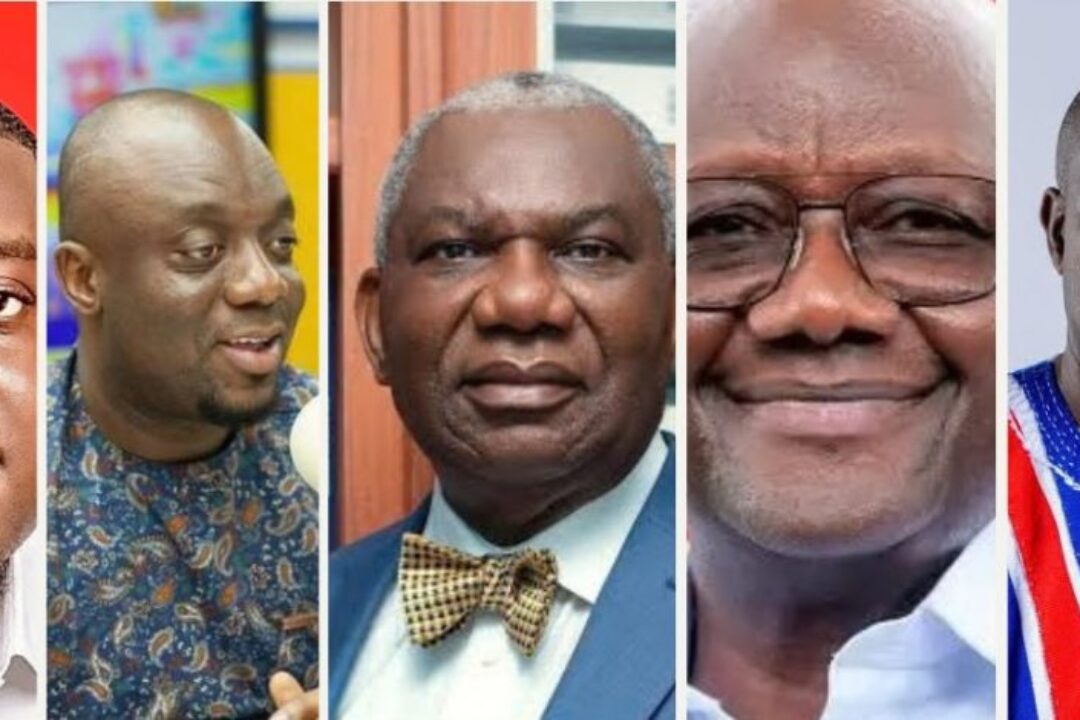


Some of the aspirants for National chairmanship and General Secretary positions
The New Patriotic Party (NPP) will gather in Kumasi, this weekend for its National Conference; where over seven thousand delegates from across the country, are not only going to elect the National Executives, but most critically, engage in a constitutional exercise that will ultimately give clearer leadership structure going forward.
With who finally becomes the national chairman, secretary, or who gets what on Saturday, already generating dramatic suspense, excitements, and anxieties, there are seven key proposals seeking to be considered by the conference.
At the zenith of these include making the presidential candidate the leader of the party rather than the National Chairman and restoring the president to the National Steering Committee.

The others are: Increasing the number of Vice Chairpersons at the national, regional and constituency levels, creating Deputy Regional and Deputy Constituency Communications Officer positions; Making the First, Second and Third Vice Chairperson positions distinct elective offices; Allowing all card-bearing members of the party to serve as delegates in presidential and parliamentary primaries; and adding Information Technology Officers to the regional and constituency executive structures.
The delegates will be considering these constitutional proposals that could fundamentally reshape the party’s command structure.
This is not simply a question of changing a title. It is a question of who leads the NPP into the 2028 presidential election, who directs its political campaign, and who ultimately carries responsibility for the outcome.
And the logic is straightforward. Once the NPP elects its presidential candidate, that individual becomes the party’s principal political face before the Ghanaian electorate. The candidate must sell the party’s message, defend its record, present its vision, and lead the campaign to win the presidency.
It therefore makes political and organisational sense for authority to follow responsibility.
TWO POWER CENTRES CREATE ROOM FOR CONFLICT
The present arrangement can create two powerful centres of political influence—the National Chairman leading the party’s institutional structure and the presidential candidate leading the presidential campaign.
Even where both sides act in good faith, overlapping authority can produce competing messages, disagreements over strategy, and unnecessary tensions between the party headquarters and the presidential campaign.
A national election is not won by ambiguity. It requires one coherent message, one coordinated strategy, and one clearly understood political command.
Making the presidential candidate the party’s political leader would remove much of that uncertainty.
The Chairman and other national officers would retain critical organisational responsibilities, while the presidential candidate would provide the political direction for the election.
That is not about weakening the Chairman. It is about creating a clearer division of responsibilities.
THE GLOBAL LESSON
The NPP would not be venturing into completely unfamiliar territory.
Major political parties around the world have developed structures that place substantial political authority in the hands of their recognised political leader while maintaining separate organisational and administrative offices.
The British Labour Party, for instance, distinguishes the role of Party Leader from that of its organisational bodies. South Africa’s African National Congress constitution identifies its president as the political head and chief directing officer of the organisation.
The lesson is not that the New Patriotic Party must copy another country’s model. The lesson is that party constitutions can deliberately separate administration from political leadership while maintaining a clear centre of political direction.
AUTHORITY MUST MATCH ACCOUNTABILITY
The most compelling argument for the proposed amendment is accountability. If the presidential candidate is expected to lead the party’s campaign and ultimately answer for its presidential performance, that candidate should have the authority necessary to shape the campaign’s political direction. That includes the campaign message, strategic priorities, and political team—within the appropriate constitutional checks and consultations.
Responsibility without corresponding authority creates confusion. Authority without accountability creates a different problem. The NPP needs neither. It needs a structure in which the person responsible for leading the presidential campaign has clearly defined authority to do so.
2028 REQUIRES UNITY OF COMMAND
The road to 2028 will demand discipline from the national leadership to the constituency and polling-station levels.
The NPP can not afford competing political narratives or uncertainty about who speaks with ultimate authority on its presidential campaign.
The proposed amendment can provide clarity. The National Chairman can remain a powerful force in organisational mobilisation, party administration, internal coordination, and grassroots development.
The presidential candidate can lead the political and electoral mission. One party. One political direction. One accountable leader for the presidential campaign. That is the essence of the proposal before delegates.
The debate in Kumasi should, therefore, rise above personalities and office-holders. The question is not who benefits today.
The question is whether the NPP’s constitution is structured to give the party the clearest possible command system for the battle ahead.
As the party looks towards 2028, clarity of leadership, unity of command, and accountability can not be treated as constitutional decoration. They are central to electoral organisation.
The delegates in Kumasi have the opportunity to settle that question.By: Gabriel Amoah