By:Isaac Amoah
The Ghana Center for Democratic Development (CDD-Ghana) has intensified its aggressive crusade to rally stakeholders for proposals for the state to regulate political campaign financing in Ghana amid the high cost of politics.
The Center on Wednesday, 2nd September, 2026, held a Media Workshop on Regulating Political Party Financing in Ghana in Kumasi, after holding similar workshops in Greater Accra on August 24, 2026, and the Northern Region on August 27, 2026, as well as the Bono Region on August 31, 2026, respectively.


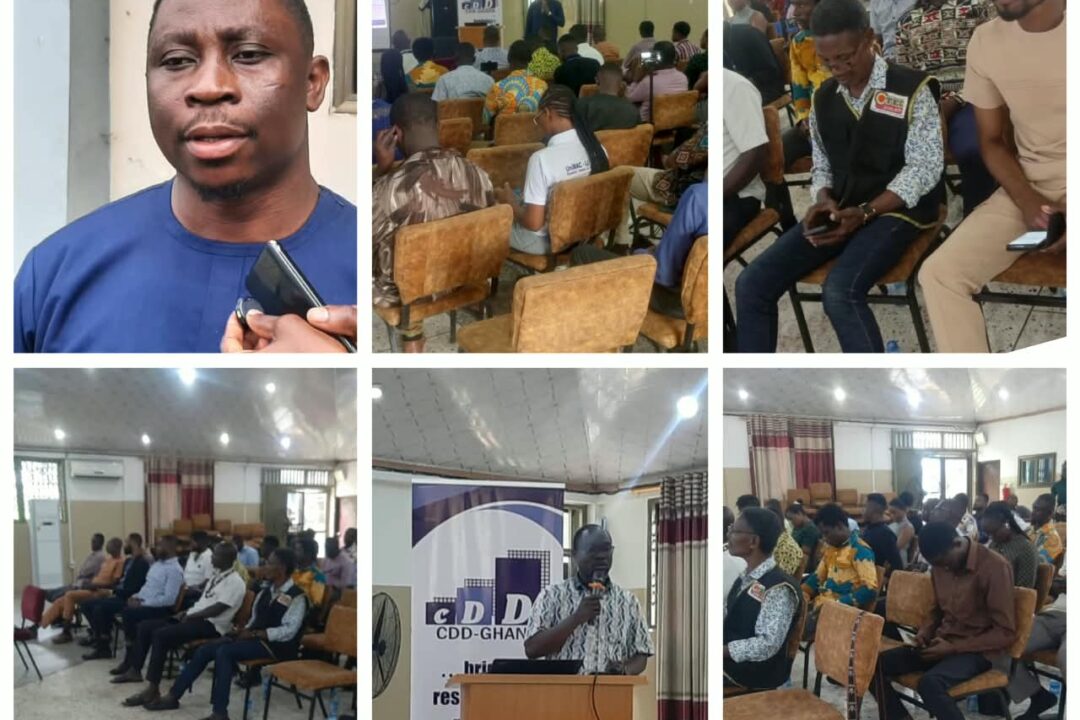
A section of the participants

The workshop, which was under the theme “The State of Political Finance in Ghana”, brought together journalists from selected print, broadcast, and online media houses.l
The workshop also featured expert presentations on the state of political parties and campaign financing in Ghana, followed by interactive discussions and question-and-answer sessions on the issues raised and the proposed regulatory reform.
The workshops afforded CDD-Ghana the opportunity to share and solicit the inputs from various stakeholders, including the media, for the Draft Model Political Finance Law.
It would be recalled that with support from the British High Commission, CDD-Ghana has developed a draft model political finance law aimed at strengthening transparency, accountability, and fairness in political party financing in Ghana.
Mr. Freddy Adu Gyamfi, the Director of Programme/Operations at the Center, said as part of this reform process, CDD-Ghana has engaged political parties, civil society organisations, the private sector, university students and youth groups and other stakeholders across the country to solicit inputs and build broad support for the proposed reforms.
According to him, recognising the critical role of the media in promoting transparency and accountability, CDD-Ghana organised a media workshop to provide journalists with an overview of the current state of political parties and campaign financing in Ghana, including key challenges and gaps in the existing legal and regulatory framework.
The workshop introduced participants to the government’s position on the Constitutional Review Commission (CRC) recommendations on political financing and the Draft Model Political Finance Law.Besides, participants got the opportunity to further examine how the proposed provisions in the Model Law seek to address existing gaps and strengthen the regulation of political party and campaign financing in Ghana.
Speaking to journalists after the workshop, Mr Joseph Oti Frimpong, Programme Officer for Elections at CDD-Ghana, expressed concern about the skyrocketing cost of politics in Ghana.
Mr Frimpong said a study conducted revealed that the cost of politics keeps on increasing, and they think that there’s an urgent need to get a law to regulate political party finance in Ghana before it gets out of hand.
According to him, per the studies on monetisation/high cost of politics for the 2012 election, a parliamentary candidate or political party needed to spend approximately GHC 124,000 at the exchange rate of GHC 5, and it increased to approximately GHC 235,000 in 2016 and four million Ghana cedis in the 2020 elections for someone who contested for Member of Parliament.
He revealed that, per the same study, the candidate for the presidential race spent approximately five hundred and seventy-nine million Ghana cedis in the 2020 general election.
He said that even though they were yet to conduct the study on the 2024 general election, CDD-Ghana and the majority of Ghanaians are worried about the high cost of political finance.

Mr Joseph Oti Frimpong
“We’re therefore looking at where political parties and various candidates get the money or resources from and how they spent it on elections.
And we think that there should be a regulation from the State to help cut down the high cost of political finance in Ghana’s politics.”
Mr Joseph Oti Frimpong recounted that the filling fees of political parties keep on also increasing. For instance, in 2016, NPP pegged it filling fees at GHC 85,000, NDC, GHC 60,000. Similarly, in the 2020 elections, NPP charged Ghc 220,000 and NDC Ghc 420,000, and in 2024, NPP and NDC pegged their filling fees at Ghc 350,000 and Ghc 530,000, respectively.
Interestingly, the cleaner observation is that whenever the political parties are in government, they don’t charge high filing fees, raising suspicion of misuse of state resources to finance their political activities. “The problem here is the abuse of incumbency. Another issue is vote buying/vote selling, demand and supply corruption, unregulated financing of candidates, and abuse of state resources and incumbency,” he noted.

some scenes from the workshop
Mr. Frimpong said sources of funding of political parties and candidates had been traced to be from licit and illicit donations from institutions, nomination fees, kickbacks & corruption, fundraising, membership dues, primaries, etc.
According to him, the cost drivers include ;politicians take care of the serial callers’ phone calls, attending and spending on weddings, funerals, Christmas donations, school fees, hospital bills, honouring of invitations from most churches, shrines, vehicles, fuel, etc.He, therefore, cautioned the public to manage their expectations from their Members of the Parliament (MPs).
This is because the MP for Walewale Abdul Kabitu Mahama is reported to have said he spends not less than Ghc 30,000 on funerals every month (Starfm.com.gh).Touching on gaps and challenges in Ghana’s political finance architecture,
Mr Joseph Oti Frimpong pointed out that there’s no campaign financing regulation, no defined campaign period, no ceiling/limits on contributions, no spending limits, no required verification of identity of donors or disclosure of donors, no constitutional requirement for publication of party accounts, and return vs enforcement.
Others include the prohibition on receiving funding from a non-citizen applying to political parties, not candidates; no prohibition on abuse of state resources/incumbency; challenges with enforcement and sanctions regime; and no mixed model of state and private funding.
In light of the above, CDD-Ghana proposed that there should be a defined campaign period in legislation, require candidates to submit a financial report detailing contributions/donations received towards the electoral campaigns, and place a ceiling on how much an individual or an organisation can contribute to address potential state capture.
Other proposals or recommendations include Strengthen EMB or replace it with a new independent organisation to effectively regulate political finance, campaign financing, and candidates; consider a mix model of private and state funding; and condition state funding on promoting state objectives to increase participation of marginalised groups (women, youth, and persons who are differently abled); and require verification of identity of donors or disclosure of donors (for donations above the stipulated threshold).
Besides, the legislation must expressly prohibit financing of political parties and candidates’ electoral campaigns from illicit, unlawful sources, ensure that fundraising events overseas are properly regulated to enable verification of the identity of donors and prohibit foreign funding.
The regulation should also address stateside filing fees and intra-party election costs to address monetisation of politics, amend current law to extend criminalisation of vote buying in national elections and referendums to intra-party electio.
According to him, it’s a major public concern of the majority of Ghanaians and not only CDD-Ghana.He, therefore, urged the media, as a major stakeholder, not to sit back but rather to support the current consensus on proposed reforms.
Mr Frimpong also pointed out the consensus on reform and action by the Constitutional Review Committee (CRC).
The consensus is reproduced below: Establish Independent Registrar and Regulator of Political Parties and Campaigns (“IRRPC”) to register and regulate political parties, sanction powers, criminalise vote buying, etc.; restrict campaign period to, e.g., 120 days; regulate campaign receipts and expenditure; regulate filing fees by candidates in intra-party and national elections; external audit of party and candidate funding, sources of funding; sanction abuse of incumbency, including criminal prosecution, Establish a Democracy Fund for public funding. Parties are to allow all members in good standing to elect parliamentary candidates and flag bearers.”