Skip to content
Menu
Menu

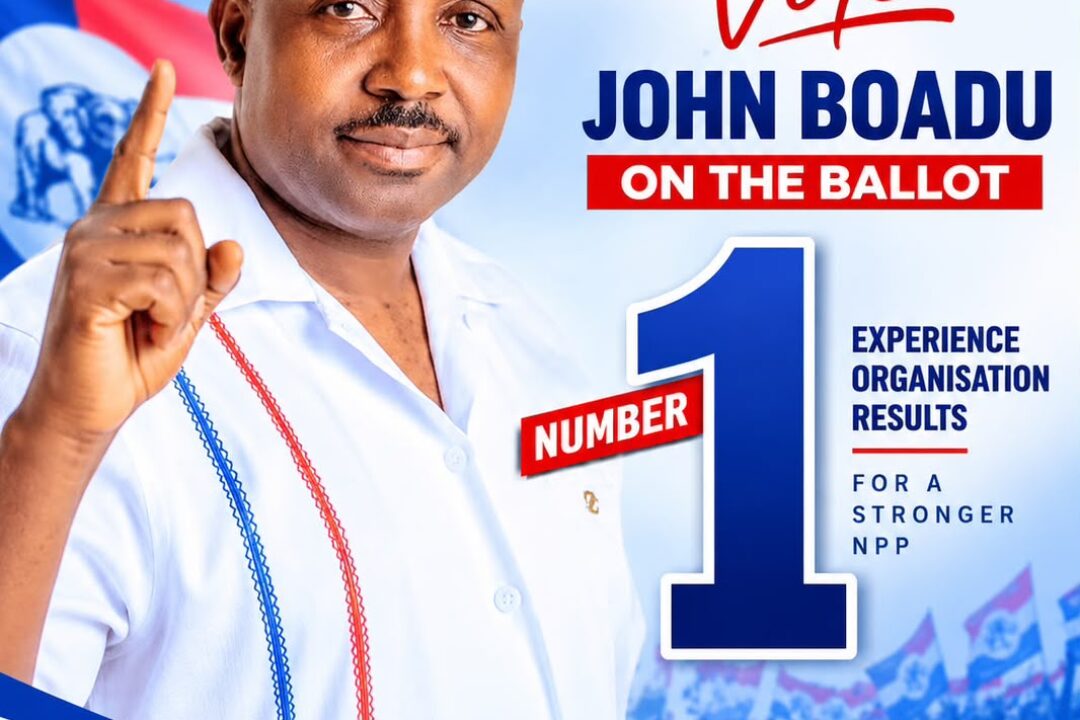
JOHN BOADU: 3 decades of  proven record for NPP national chairmanship & compatibility with Bawumia’s presidency


  1. Introduction: The Significance of the National Chairmanship

The National Chairmanship of the NPP requires political experience, organizational competence, institutional knowledge, respect for the Party’s Constitution, and the ability to unite the Party around a common objective. As the NPP prepares for the 2028 general elections, the Party requires a National Chairman with a proven record of political leadership, organizational competence, grassroots engagement and, importantly, the ability to work effectively with Dr. Mahamudu Bawumia, the Party’s Presidential Candidate.

John Boadu’s more than three decades of service at the polling station, constituency, regional, and national levels provide a strong foundation for considering his suitability for the position. His extensive experience in Party organization, electoral campaigns, and national administration gives him valuable institutional knowledge of the Party and its structures. The important question, therefore, is how can John Boadu’s experience, institutional knowledge, and organizational capacity contribute to building a stronger, more united, and better-prepared NPP for the 2028 elections?

  1. Over Three Decades of Service at Every Level of the Party

One of John Boadu’s most distinguishing attributes is the breadth of his experience within the NPP. He is the only Party officer to have served in executive positions at every level, from polling station through constituency and regional structures to the national level. The positions he occupied included Polling Station Chairman, Constituency Secretary, Research and Information Director for the Greater Accra Region, National Finance Officer, National Youth Treasurer, National Youth Organizer, Deputy National Communications Director, National Organizer and General Secretary. He has also served as Director of National Campaign Operations and Logistics for the 2016 and 2020 general elections.


tntnewspapergh.com


John Boadu’s involvement in the Party predates the establishment of the Fourth Republic. As a young activist, he participated in the Danquah-Busia Club alongside senior members of the political tradition, including John Agyekum Kufuor, Chairman Da Rocha, and Nana Akufo-Addo He subsequently served as a polling agent in the 1996 elections and as a trainer of trainers in the Greater Accra and Volta Regions ahead of the 2000 general elections.

His involvement in the Party’s political tradition predates the Fourth Republic. As a young activist, he participated in the Danquah-Busia Club alongside senior figures, including John Agyekum Kufuor, Chairman Da Rocha, and Nana Akufo-Addo He later served as a polling agent in the 1996 elections and as a trainer of trainers in the Greater Accra and Volta Regions ahead of the 2000 elections.

Joining the NPP National Secretariat in 2001, he progressively took on responsibilities in finance, youth organization, communications, national organization, campaign operations, and party administration, eventually becoming General Secretary. This progression has given John Boadu an understanding of the Party from both the grassroots and national leadership perspectives. More importantly, it has provided him with institutional knowledge of how decisions at the national level translate into realities for constituency executives, polling station officers, and ordinary Party members.

  1. Election Management and the 2016 Victory

John Boadu’s experience in election management is another important aspect of his record. In the run-up to the 2016 general elections, following the suspension of the then National Chairman and General Secretary during an internal Party crisis, John Boadu, who was then National Organizer, assumed additional responsibilities as Acting General Secretary and Director of National Campaign Operations.


In these roles, he was involved in coordinating Party structures, campaign activities, logistics, and aspects of national Party administration at a critical period. He undertook these responsibilities while the Party was managing significant internal challenges and preparing for a highly competitive national election.

The NPP subsequently won the 2016 presidential election by more than one million votes and gained 55 parliamentary seats from the then governing NDC. While electoral outcomes are shaped by multiple political, economic and social factors, John Boadu’s responsibilities during the 2016 campaign demonstrate his experience in coordinating a national political organization, managing campaign operations and maintaining Party structures under challenging circumstances.

  1. Election Management Beyond 2016: The 2020 Experience

John Boadu’s election-management experience extends beyond the 2016 elections. In the run-up to the election, he introduced and successfully implemented the “Adopt-a-Polling-Station and Constituency” campaign strategy, encouraging individual Party members and organized groups to identify specific polling stations or constituencies and provide targeted campaign resources and logistics.

Another significant contribution of John Boadu was the rollout of the NPP’s Pink Sheet Tracking System, an IT-based election management platform that enabled the Party to collate results from approximately 38,000 polling stations in less than 12 hours after the polls. The system provided the Party with a centralized and efficient mechanism for tracking and consolidating results nationwide. These initiatives demonstrate John Boadu’s ability to combine grassroots mobilization, campaign logistics, and technology-driven election management, experience that remains relevant to the NPP’s preparations for the 2028 elections

  1. Strengthening Party Structures and Secretariat Operations

A political party’s organizational strength depends partly on the capacity and resources available to its structures. During his tenure as General Secretary, John Boadu contributed significantly to efforts to establish permanent Party offices in constituencies and regions that lacked them while supporting the provision of essential facilities and IT infrastructure for Party secretariats These interventions helped strengthen administration, communication, record-keeping, and electoral operations at the grassroots.

Beyond elections, permanent offices, and properly equipped secretariats provide a foundation for continuous engagement with members and effective implementation of Party programmes and directives. For the National Chairmanship, this experience is relevant to the task of strengthening the Party’s organizational infrastructure and keeping its structures active and effective between elections.

  1. Financial Support for Constituencies and Regions

John Boadu’s record also includes efforts to strengthen the financial capacity of the Party’s structures. During his tenure, he worked towards the provision of monthly subventions to the Party’s 275 constituencies and 16 regions, as well as monthly allowances for regional and constituency secretaries. These unprecedented measures were intended to ease the financial burden on local executives and enable them to carry out their responsibilities more effectively.

The broader principle is that strong grassroots structures require not only leadership and direction but also reliable and sustainable resources. Properly funded local structures are better positioned to maintain continuous engagement with members and support Party activities between elections. John Boadu’s experience in developing these financial arrangements therefore provides relevant institutional knowledge for strengthening the financial sustainability and operational effectiveness of the NPP’s constituency and regional structures.

  1. Empowering Party Members and Recognizing Grassroots Service

John Boadu has, over the years, made the empowerment of Party members and executives an important part of his political work, including advocating for opportunities that recognize their service to the Party. During his tenure as General Secretary, he consistently made the case for committed Party members and executives to be considered for public appointments. Through his efforts, more than 70% of the MMDCEs appointed during President Akufo-Addo’s tenure came from among the Party’s constituency executives.

He also advocated for opportunities for Regional and Constituency Secretaries to serve as Regional and District Managers of the National Health Insurance Authority; Organizers as Regional and District NADMO Coordinators; Youth Organizers as Regional and District Coordinators of the Youth Employment Agency; and Women Organizers as Regional and Constituency Coordinators of the School Feeding Programme. These efforts reflect an approach centred on recognizing grassroots service, empowering Party members, and strengthening the connection between Party structures and opportunities for public service, subject to applicable appointment requirements and public-service rules.

  1. Founding Role in the Youth Wing and the Development of TESCON

John Boadu’s involvement in youth organization is an important part of his political history. He was a founding member of the NPP Youth Wing and participated in efforts to secure formal recognition for youth within the Party’s organizational structure. At the Party’s 2002 Congress, he was elected its first National Youth Treasurer and later served as National Youth Organizer from 2004 to 2008.

During his tenure, he instituted the first National Youth Conference in 2008, creating a platform for young members to deliberate on issues affecting them and present proposals to the Party’s national leadership.

Instructively, the Boadu-led Youth played a key role in the formation of the Tertiary Students Confederacy of the NPP (TESCON). He further spearheaded processes that contributed to constitutional amendments in 2010 granting TESCON voting rights at the Party’s elective conferences.

This reform strengthened the institutional role of the tertiary wing by creating greater opportunities for parliamentary, constituency, regional, and national executive aspirants, as well as presidential candidates, to engage directly with tertiary students. It also provided a platform for young members to articulate their concerns and influence the policy discussions of prospective Party leaders.

The experience is relevant to the National Chairmanship because it demonstrates an approach to institutionalizing youth participation, developing future leaders, and creating meaningful pathways for young members to engage in the Party’s decision-making processes.

  1. International Experience and Recognition

John Boadu’s political experience also extends beyond Ghana through engagements with international political organizations, including the UK Conservative Party, Communist Party of China, Germany’s Christian Democratic Union, and the International Democratic Union.

On 25th September 2020, he was elected Deputy Chairman of the Democratic Union of Africa, having previously served as its Vice-Chair for West Africa. He also served as Secretary-General of the Organization of African Liberal Youth from 2003 to 2006. These roles have provided him with experience in international political engagement, inter-party relations, and the administration of political networks beyond Ghana.

For the NPP, such exposure offers an additional perspective on party organization, political communication, electoral management and institutional development, particularly as the Party seeks to strengthen its structures and engage with political developments across Africa and beyond.

  1. Institutional Discipline and Respect for Collective Decisions

The National Chairman must operate within the Party’s constitutional framework and respect the authority of the National Council, National Executive Committee, National Steering Committee, and other relevant organs. John Boadu’s record as General Secretary demonstrates that, even when he disagreed with decisions of these bodies, he communicated and implemented them in his official capacity and defended the collective position publicly.

The NPP needs a chairman who manages disagreements within the Party’s structures rather than publicly criticizing legitimate decisions. In this regard, John Boadu’s record contrasts with that of his contenders who have publicly challenged decisions of Party organs. His institutional discipline, respect for collective decisions, and ability to place the Party’s position above personal views are important qualities for maintaining unity ahead of 2028.

  1. Loyalty to the Party After the 2022 General Secretary Election

John Boadu’s political journey also includes the experience of losing his bid for re-election as General Secretary at the 2022 National Delegates Conference. Despite the setback, he remained active in Party Affairs, attending National Council and National Executive Committee meetings and continuing to represent the NPP in the media.

He was subsequently appointed a Senior Campaign Aide to Dr. Mahamudu Bawumia for the 2024 presidential campaign. This aspect of his record demonstrates his continued commitment to the Party even after losing an internal election, highlighting the importance of loyalty to the organization beyond personal political ambitions.

  1. John Boadu’s Longstanding Working Relationship with Dr. Mahamudu Bawumia

Unlike some of his contenders, John Boadu does not need to establish his relationship with Dr. Mahamudu Bawumia as part of a Chairmanship campaign. Their association dates back to 2008, when John Boadu was appointed Dr. Bawumia’s first spokesperson following his selection as the NPP’s Vice-Presidential Candidate. Their working relationship continued over the years, including John Boadu’s role as a senior campaign aide during the 2024 presidential campaign.

This relationship is reinforced by John Boadu’s more than 30 years of continuous service to the NPP at various levels, during which he has built extensive institutional experience and a record of Party service and cooperation. His relationship with Dr. Bawumia is, therefore, not merely a campaign claim; it is grounded in a longstanding history of working together. Combined with his experience in Party administration and election management, this provides a practical foundation for coordination between the National Chairman, the Party’s structures, and the Presidential Candidate as the NPP prepares for 2028.

  1. The Leadership Requirements of the 2028 Election Cycle

The 2028 elections will require effective coordination among the NPP’s national, regional, constituency, and polling station structures, as well as its youth and other Party organs. The National Chairman will be expected to strengthen communication, facilitate the implementation of Party decisions, manage internal disagreements, and support effective campaign coordination.

John Boadu’s record covers many of these areas. He has served at different levels of the Party, managed campaign operations in two general elections, contributed to election-management systems, supported Party secretariats and local structures, and played key roles in youth organization and TESCON His experience as General Secretary, continued Party engagement after 2022, and involvement in the 2024 presidential campaign further provide relevant experience for the responsibilities of the office.

  1. An Appeal to Delegates: Consider the Record on Saturday

Distinguished delegates, on Saturday, October 3, you will have the responsibility of choosing the NPP’s next National Chairman. As you exercise that responsibility, I respectfully urge you to look beyond campaign messages and consider the record, experience, and contribution of each candidate to the Party.

John Boadu brings more than three decades of continuous service to the NPP, spanning grassroots organization, national party administration, campaign management, electoral technology, youth leadership, party development, and service as General Secretary His continued engagement after the 2022 internal election and his longstanding working relationship with Dr. Mahamudu Bawumia since 2008 is also part of that record.

You will also be choosing a National Chairman for a critical period leading to the 2028 general elections. The office will require institutional knowledge, organizational discipline, the ability to coordinate Party structures, respect for collective decisions, and constructive engagement with the Party’s leadership and Presidential Candidate.

Distinguished delegates, the record is before you. Consider the experience each candidate brings, the responsibilities of the office, and the demands of the road to 2028. Consider who has demonstrated the breadth of experience necessary to work across the Party’s structures and help strengthen its organization. On Saturday, let the record, experience, and leadership capacity of the candidates guide your decision as you determine the future direction of the National Chairmanship and, ultimately, the organizational preparedness of the NPP for 2028.Assalamu aalai.Source:Iddi Muhayu-Deen Esq.

#ForGodAndCountry


JOHN BOADU: 3 decades of  proven record for NPP national chairmanship & compatibility with Bawumia’s presidency


  1. Introduction: The Significance of the National Chairmanship

The National Chairmanship of the NPP requires political experience, organizational competence, institutional knowledge, respect for the Party’s Constitution, and the ability to unite the Party around a common objective. As the NPP prepares for the 2028 general elections, the Party requires a National Chairman with a proven record of political leadership, organizational competence, grassroots engagement and, importantly, the ability to work effectively with Dr. Mahamudu Bawumia, the Party’s Presidential Candidate.

John Boadu’s more than three decades of service at the polling station, constituency, regional, and national levels provide a strong foundation for considering his suitability for the position. His extensive experience in Party organization, electoral campaigns, and national administration gives him valuable institutional knowledge of the Party and its structures. The important question, therefore, is how can John Boadu’s experience, institutional knowledge, and organizational capacity contribute to building a stronger, more united, and better-prepared NPP for the 2028 elections?

  1. Over Three Decades of Service at Every Level of the Party

One of John Boadu’s most distinguishing attributes is the breadth of his experience within the NPP. He is the only Party officer to have served in executive positions at every level, from polling station through constituency and regional structures to the national level. The positions he occupied included Polling Station Chairman, Constituency Secretary, Research and Information Director for the Greater Accra Region, National Finance Officer, National Youth Treasurer, National Youth Organizer, Deputy National Communications Director, National Organizer and General Secretary. He has also served as Director of National Campaign Operations and Logistics for the 2016 and 2020 general elections.


tntnewspapergh.com


John Boadu’s involvement in the Party predates the establishment of the Fourth Republic. As a young activist, he participated in the Danquah-Busia Club alongside senior members of the political tradition, including John Agyekum Kufuor, Chairman Da Rocha, and Nana Akufo-Addo He subsequently served as a polling agent in the 1996 elections and as a trainer of trainers in the Greater Accra and Volta Regions ahead of the 2000 general elections.

His involvement in the Party’s political tradition predates the Fourth Republic. As a young activist, he participated in the Danquah-Busia Club alongside senior figures, including John Agyekum Kufuor, Chairman Da Rocha, and Nana Akufo-Addo He later served as a polling agent in the 1996 elections and as a trainer of trainers in the Greater Accra and Volta Regions ahead of the 2000 elections.

Joining the NPP National Secretariat in 2001, he progressively took on responsibilities in finance, youth organization, communications, national organization, campaign operations, and party administration, eventually becoming General Secretary. This progression has given John Boadu an understanding of the Party from both the grassroots and national leadership perspectives. More importantly, it has provided him with institutional knowledge of how decisions at the national level translate into realities for constituency executives, polling station officers, and ordinary Party members.

  1. Election Management and the 2016 Victory

John Boadu’s experience in election management is another important aspect of his record. In the run-up to the 2016 general elections, following the suspension of the then National Chairman and General Secretary during an internal Party crisis, John Boadu, who was then National Organizer, assumed additional responsibilities as Acting General Secretary and Director of National Campaign Operations.


In these roles, he was involved in coordinating Party structures, campaign activities, logistics, and aspects of national Party administration at a critical period. He undertook these responsibilities while the Party was managing significant internal challenges and preparing for a highly competitive national election.

The NPP subsequently won the 2016 presidential election by more than one million votes and gained 55 parliamentary seats from the then governing NDC. While electoral outcomes are shaped by multiple political, economic and social factors, John Boadu’s responsibilities during the 2016 campaign demonstrate his experience in coordinating a national political organization, managing campaign operations and maintaining Party structures under challenging circumstances.

  1. Election Management Beyond 2016: The 2020 Experience

John Boadu’s election-management experience extends beyond the 2016 elections. In the run-up to the election, he introduced and successfully implemented the “Adopt-a-Polling-Station and Constituency” campaign strategy, encouraging individual Party members and organized groups to identify specific polling stations or constituencies and provide targeted campaign resources and logistics.

Another significant contribution of John Boadu was the rollout of the NPP’s Pink Sheet Tracking System, an IT-based election management platform that enabled the Party to collate results from approximately 38,000 polling stations in less than 12 hours after the polls. The system provided the Party with a centralized and efficient mechanism for tracking and consolidating results nationwide. These initiatives demonstrate John Boadu’s ability to combine grassroots mobilization, campaign logistics, and technology-driven election management, experience that remains relevant to the NPP’s preparations for the 2028 elections

  1. Strengthening Party Structures and Secretariat Operations

A political party’s organizational strength depends partly on the capacity and resources available to its structures. During his tenure as General Secretary, John Boadu contributed significantly to efforts to establish permanent Party offices in constituencies and regions that lacked them while supporting the provision of essential facilities and IT infrastructure for Party secretariats These interventions helped strengthen administration, communication, record-keeping, and electoral operations at the grassroots.

Beyond elections, permanent offices, and properly equipped secretariats provide a foundation for continuous engagement with members and effective implementation of Party programmes and directives. For the National Chairmanship, this experience is relevant to the task of strengthening the Party’s organizational infrastructure and keeping its structures active and effective between elections.

  1. Financial Support for Constituencies and Regions

John Boadu’s record also includes efforts to strengthen the financial capacity of the Party’s structures. During his tenure, he worked towards the provision of monthly subventions to the Party’s 275 constituencies and 16 regions, as well as monthly allowances for regional and constituency secretaries. These unprecedented measures were intended to ease the financial burden on local executives and enable them to carry out their responsibilities more effectively.

The broader principle is that strong grassroots structures require not only leadership and direction but also reliable and sustainable resources. Properly funded local structures are better positioned to maintain continuous engagement with members and support Party activities between elections. John Boadu’s experience in developing these financial arrangements therefore provides relevant institutional knowledge for strengthening the financial sustainability and operational effectiveness of the NPP’s constituency and regional structures.

  1. Empowering Party Members and Recognizing Grassroots Service

John Boadu has, over the years, made the empowerment of Party members and executives an important part of his political work, including advocating for opportunities that recognize their service to the Party. During his tenure as General Secretary, he consistently made the case for committed Party members and executives to be considered for public appointments. Through his efforts, more than 70% of the MMDCEs appointed during President Akufo-Addo’s tenure came from among the Party’s constituency executives.

He also advocated for opportunities for Regional and Constituency Secretaries to serve as Regional and District Managers of the National Health Insurance Authority; Organizers as Regional and District NADMO Coordinators; Youth Organizers as Regional and District Coordinators of the Youth Employment Agency; and Women Organizers as Regional and Constituency Coordinators of the School Feeding Programme. These efforts reflect an approach centred on recognizing grassroots service, empowering Party members, and strengthening the connection between Party structures and opportunities for public service, subject to applicable appointment requirements and public-service rules.

  1. Founding Role in the Youth Wing and the Development of TESCON

John Boadu’s involvement in youth organization is an important part of his political history. He was a founding member of the NPP Youth Wing and participated in efforts to secure formal recognition for youth within the Party’s organizational structure. At the Party’s 2002 Congress, he was elected its first National Youth Treasurer and later served as National Youth Organizer from 2004 to 2008.

During his tenure, he instituted the first National Youth Conference in 2008, creating a platform for young members to deliberate on issues affecting them and present proposals to the Party’s national leadership.

Instructively, the Boadu-led Youth played a key role in the formation of the Tertiary Students Confederacy of the NPP (TESCON). He further spearheaded processes that contributed to constitutional amendments in 2010 granting TESCON voting rights at the Party’s elective conferences.

This reform strengthened the institutional role of the tertiary wing by creating greater opportunities for parliamentary, constituency, regional, and national executive aspirants, as well as presidential candidates, to engage directly with tertiary students. It also provided a platform for young members to articulate their concerns and influence the policy discussions of prospective Party leaders.

The experience is relevant to the National Chairmanship because it demonstrates an approach to institutionalizing youth participation, developing future leaders, and creating meaningful pathways for young members to engage in the Party’s decision-making processes.

  1. International Experience and Recognition

John Boadu’s political experience also extends beyond Ghana through engagements with international political organizations, including the UK Conservative Party, Communist Party of China, Germany’s Christian Democratic Union, and the International Democratic Union.

On 25th September 2020, he was elected Deputy Chairman of the Democratic Union of Africa, having previously served as its Vice-Chair for West Africa. He also served as Secretary-General of the Organization of African Liberal Youth from 2003 to 2006. These roles have provided him with experience in international political engagement, inter-party relations, and the administration of political networks beyond Ghana.

For the NPP, such exposure offers an additional perspective on party organization, political communication, electoral management and institutional development, particularly as the Party seeks to strengthen its structures and engage with political developments across Africa and beyond.

  1. Institutional Discipline and Respect for Collective Decisions

The National Chairman must operate within the Party’s constitutional framework and respect the authority of the National Council, National Executive Committee, National Steering Committee, and other relevant organs. John Boadu’s record as General Secretary demonstrates that, even when he disagreed with decisions of these bodies, he communicated and implemented them in his official capacity and defended the collective position publicly.

The NPP needs a chairman who manages disagreements within the Party’s structures rather than publicly criticizing legitimate decisions. In this regard, John Boadu’s record contrasts with that of his contenders who have publicly challenged decisions of Party organs. His institutional discipline, respect for collective decisions, and ability to place the Party’s position above personal views are important qualities for maintaining unity ahead of 2028.

  1. Loyalty to the Party After the 2022 General Secretary Election

John Boadu’s political journey also includes the experience of losing his bid for re-election as General Secretary at the 2022 National Delegates Conference. Despite the setback, he remained active in Party Affairs, attending National Council and National Executive Committee meetings and continuing to represent the NPP in the media.

He was subsequently appointed a Senior Campaign Aide to Dr. Mahamudu Bawumia for the 2024 presidential campaign. This aspect of his record demonstrates his continued commitment to the Party even after losing an internal election, highlighting the importance of loyalty to the organization beyond personal political ambitions.

  1. John Boadu’s Longstanding Working Relationship with Dr. Mahamudu Bawumia

Unlike some of his contenders, John Boadu does not need to establish his relationship with Dr. Mahamudu Bawumia as part of a Chairmanship campaign. Their association dates back to 2008, when John Boadu was appointed Dr. Bawumia’s first spokesperson following his selection as the NPP’s Vice-Presidential Candidate. Their working relationship continued over the years, including John Boadu’s role as a senior campaign aide during the 2024 presidential campaign.

This relationship is reinforced by John Boadu’s more than 30 years of continuous service to the NPP at various levels, during which he has built extensive institutional experience and a record of Party service and cooperation. His relationship with Dr. Bawumia is, therefore, not merely a campaign claim; it is grounded in a longstanding history of working together. Combined with his experience in Party administration and election management, this provides a practical foundation for coordination between the National Chairman, the Party’s structures, and the Presidential Candidate as the NPP prepares for 2028.

  1. The Leadership Requirements of the 2028 Election Cycle

The 2028 elections will require effective coordination among the NPP’s national, regional, constituency, and polling station structures, as well as its youth and other Party organs. The National Chairman will be expected to strengthen communication, facilitate the implementation of Party decisions, manage internal disagreements, and support effective campaign coordination.

John Boadu’s record covers many of these areas. He has served at different levels of the Party, managed campaign operations in two general elections, contributed to election-management systems, supported Party secretariats and local structures, and played key roles in youth organization and TESCON His experience as General Secretary, continued Party engagement after 2022, and involvement in the 2024 presidential campaign further provide relevant experience for the responsibilities of the office.

  1. An Appeal to Delegates: Consider the Record on Saturday

Distinguished delegates, on Saturday, October 3, you will have the responsibility of choosing the NPP’s next National Chairman. As you exercise that responsibility, I respectfully urge you to look beyond campaign messages and consider the record, experience, and contribution of each candidate to the Party.

John Boadu brings more than three decades of continuous service to the NPP, spanning grassroots organization, national party administration, campaign management, electoral technology, youth leadership, party development, and service as General Secretary His continued engagement after the 2022 internal election and his longstanding working relationship with Dr. Mahamudu Bawumia since 2008 is also part of that record.

You will also be choosing a National Chairman for a critical period leading to the 2028 general elections. The office will require institutional knowledge, organizational discipline, the ability to coordinate Party structures, respect for collective decisions, and constructive engagement with the Party’s leadership and Presidential Candidate.

Distinguished delegates, the record is before you. Consider the experience each candidate brings, the responsibilities of the office, and the demands of the road to 2028. Consider who has demonstrated the breadth of experience necessary to work across the Party’s structures and help strengthen its organization. On Saturday, let the record, experience, and leadership capacity of the candidates guide your decision as you determine the future direction of the National Chairmanship and, ultimately, the organizational preparedness of the NPP for 2028.Assalamu aalai.Source:Iddi Muhayu-Deen Esq.

#ForGodAndCountry


Related Stories
Popular Stories