Source: Isaac Amoah
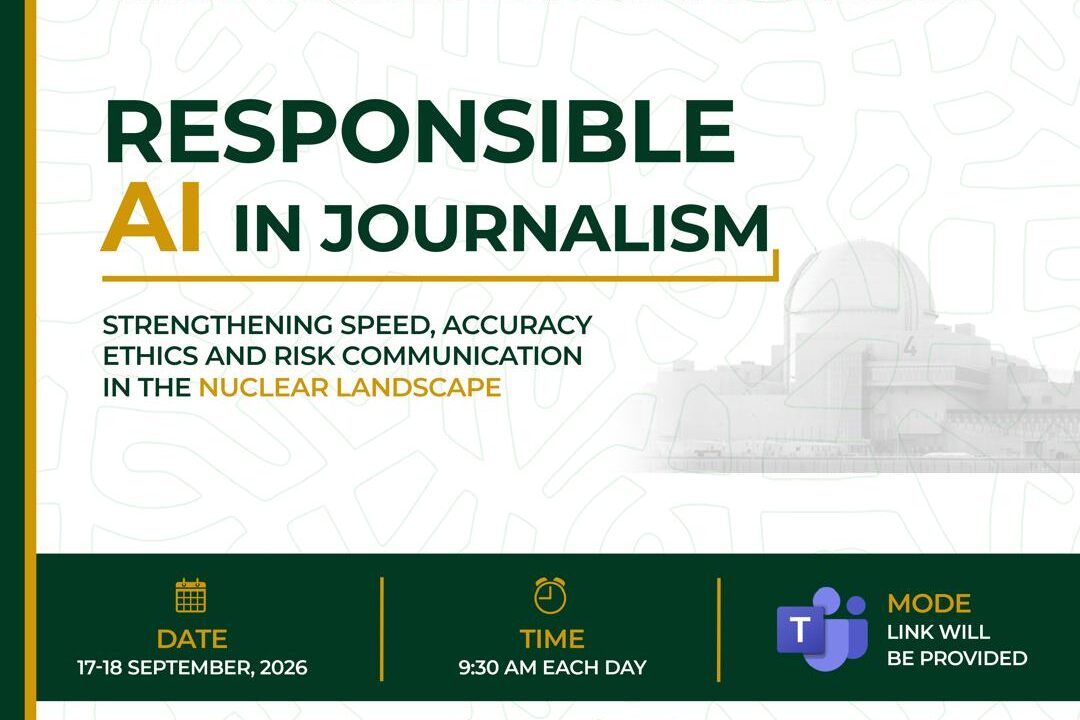
Over seventy (70) media professionals across the country have been trained on how to use artificial intelligence (AI) responsibly in journalism in a two-day virtual workshop organised by Nuclear Power Ghana (NPA), in partnership with the Ghana Journalists Association (GJA), Ghana News Agency (GNA), Private Newspaper and Online News Association of Ghana (PRINPAG), and other stakeholders.
The workshop which was on the theme “Responsible AI in Journalism: Strengthening Speed, Accuracy, Ethics and Risk Communication in the Nuclear Landscape” was held from Thursday, September 17, to Friday, September 18, 2026, via Microsoft Teams.


Facilitators of the virtual workshop included Javier Farias, consultant, strategic communication/IAEA expert; Zakaria Tanko Musah, ESQ, lecturer, UniMAC & private legal practitioner, as well as Dr. Charles Nii Ayiku Ayiku, General Manager, External Communications, Electricity Company of Ghana (ECG).
Speaking on the topic “AI as a Technology and a Media Tool in Reporting”, Dr. Ayiku Ayiku said “the question is no longer whether journalists will use AI. The question is whether they will use it responsibly enough to preserve accuracy, accountability and public trust.”
He, therefore, stressed the importance of the topic because every newsroom now has AI in it, wheher or not the newsroom has decided to use AI.

According to him, nuclear reporting raises the cost of getting it wrong, adding that nuclear rumours travel faster than regulators, and now they arrive fully illustrated.
He reminded media professionals that nuclear journalism is not just technical reporting, but rather risk communication carried out in public under deadline, with consequences for behaviour.
He observed that AI is being applied or actively explored across nuclear operations, science, and oversight.
On where AI fits in the reporting process, he mentioned research, analyses, verification, interviews, writing, editing, publishing, and monitoring.
On what journalists must never outsource, he mentioned nine responsibilities that stay with a human being who can be named, questioned and held accountable. The responsibilities he listed included editorial judgment, source protection, verification of facts, attribution, fairness and right of reply, interpreting sensitive evidence as well as decisions that risk harm.
He indicated that even though AI can assist judgment, it must never become the source of judgment.
On his part, Communications & Stakeholder Engagement expert, Javier Farias, who made a presentation on the topic “Nuclear Risk Communication & Public Assurance,” stated that hazards and risks are related, but not identical.
According to him, hazard is anything that has the potential to cause harm, while risk is the probability or likelihood that harm will occur as a result of exposure to a hazard.
He said risk perception is subjective and mainly related to feelings about radiation.
Farias said radiation risk perception is a well-studied subject: they follow consistent patterns and rationales. Perceptions follow consistent patterns, but their expression may vary with culture or time.
The stakeholder engagement expert said the public think differently about radiation risks than experts, adding that the public perceive and respond to risky situations based on emotions in addition to facts.
According to him, what matters most is how those facts feel. He said emotions could play a bigger role in the way people perceive risks than reason and rational thinking. He added that nuclear risk communication carries a heavier burden.
He emphasised that nuclear risk communication needed to treat fears as facts, not simple anxieties. He said understanding emotional risk perception factors helps communicators to express empathy and respect.
This, according to him, would help build trust, adding that trust is built before you need it.