By:Isaac Amoah
An environmental journalist with multiple awards winning, Mr. Erastus Asare Donkor, a journalist with multimedia groups in Ghana, has encouraged journalists, especially the upcoming ones, to develop a keen interest in environmental reporting to help save the environment.
According to him, despite the huge risk involved, it’s equally rewarding to specialize in environmental reporting.


Mr. Erastus Asare Donkor in an interview after the workshop
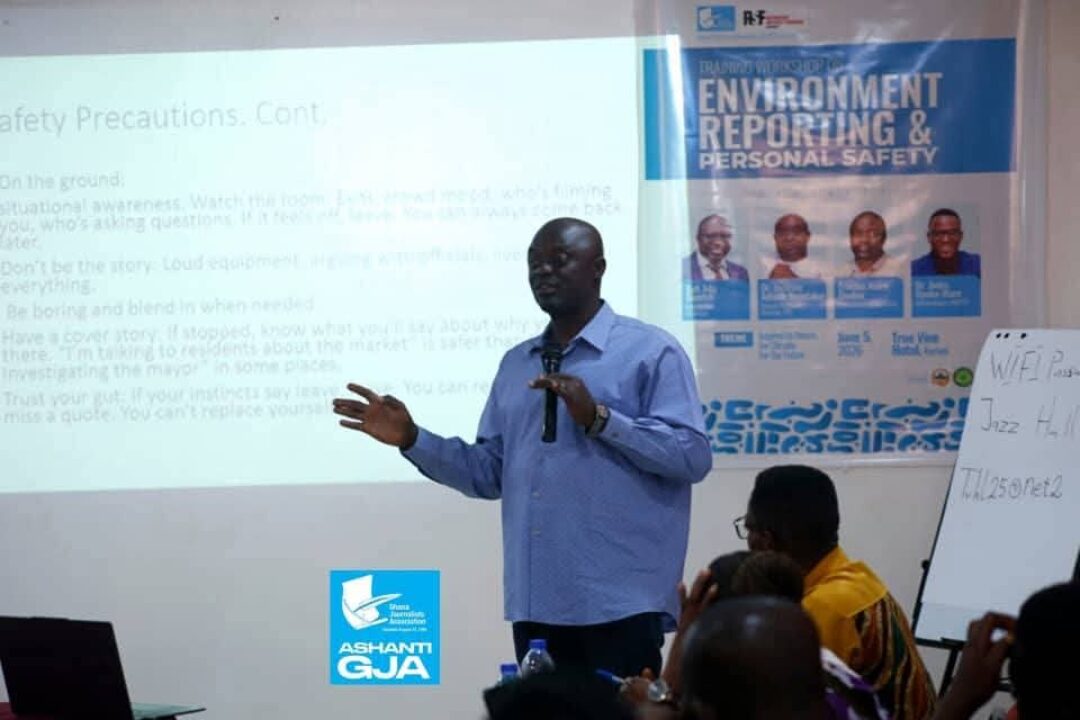
Sharing his experience at day’s capacity-building workshop organized by the Ashanti Regional chapter of Ghana Journalists Association (GJA) in partnership with Reporters Without Borders-Germany, which was facilitated by Mr. Donkor, he mentioned the potential challenges such as threats and intimidation and life-threatening intimidation and attacks from individuals associated with illegal mining activities.

Mr. Erastus Asare Donkor Sharing his experience

He revealed how he was physically attacked twice in gathering evidence.
He therefore cautioned journalists to always do risk assessment in order to prevent physical attacks by politically exposed persons and duty bearers.
The training workshop held on Friday, 5th June, 2026, at True Vine Hotel in Kumasi, the Ashanti Regional capital, was part of Erastus Asare Donkor’s 2025 Research and Recharge Fellowship with Reporters Without Borders-Germany.
That part of the fellowship was to enable Erastus to share his experiences on how to impact young journalists to report safely on the environment.
Mr. Erastus Asare Donkor, therefore, encourages journalists, especially the young journalists, to stand up in environmental reporting.
On what keeps him still in such a risky area, he said it’s even more risky to stay in environmental reporting than to leave it.
According to him, journalists are duty-bound to protect our environment and people from risk associated with environmental pollution.He revealed how he and his team efforts have saved several forest reserves, jobs, and lives.

Participants in a group photograph
Mr. Erastus Asare Donkor said what they need to take up for environmental reporting includes Passion, motivation, curiosity, determination, emotional resilience, legal and safety awareness, relentless skepticism, and patience.
He also shared how journalists could get story ideas—information/whistleblowers, fact-checking, data and public records, following money and policy, scientists/researchers/experts, tracking patients, and contradicting
For information gathering, they need the right/compelling materials, charity, facts they can verify, etc.
Mr. Kofi Adu Domfeh, the Ashanti Regional Chairman of GJA, in opening remarks at the capacity building workshop, said, “Indeed, this is a family gathering with a green purpose.”

Mr. Adu Domfeh speaking at the event
He said that when they planned this training workshop, the intent was not for it to coincide with World Environment Day, but “here we are today, making it all count on the theme ‘Inspired by Nature. For Climate.'” For Our Future.”

Mr. Kofi Adu Domfeh
Mr. Domfeh continued that, but “when we (GJA-RSF Germany) planned this session, we surely knew the perennial flooding of our cities was once again dawning.
We knew our forests, our water bodies, our biodiversity, our lungs, and our very existence are under the scourge of illegal mining, that ugly foe called galamsey.
When we planned this session, we knew our beautiful Lake Bosomtwe was under unprovoked attack, and we knew our wetlands were being sacrificed for brick and mortar.
But we also knew that journalists have a role to play in sustainability, and in playing their role, they sometimes face risks in different shapes!
Mr. Kofi Adu Domfeh is a key brain behind Erastus Asare Donkor’s works and said, “We at Ashanti GJA are glad to have it all here for this training on environmental reporting and personal safety.”This is no talk shop.
This is a call for each of us to self-introspect on environmental stewardship towards sustainability. While we look at the big picture of reporting what matters most to good environmental practices, we should also be looking at our individual actions in promoting climate action, including greening our microenvironments.
He therefore expressed Ashanti GJA’s gratitude to Erastus Asare Donkor for the goodwill to see this training happen through the small grant facility from Reporters Without Borders (RSF Germany) and to our resource person for accepting to be part of this without any hesitation.”