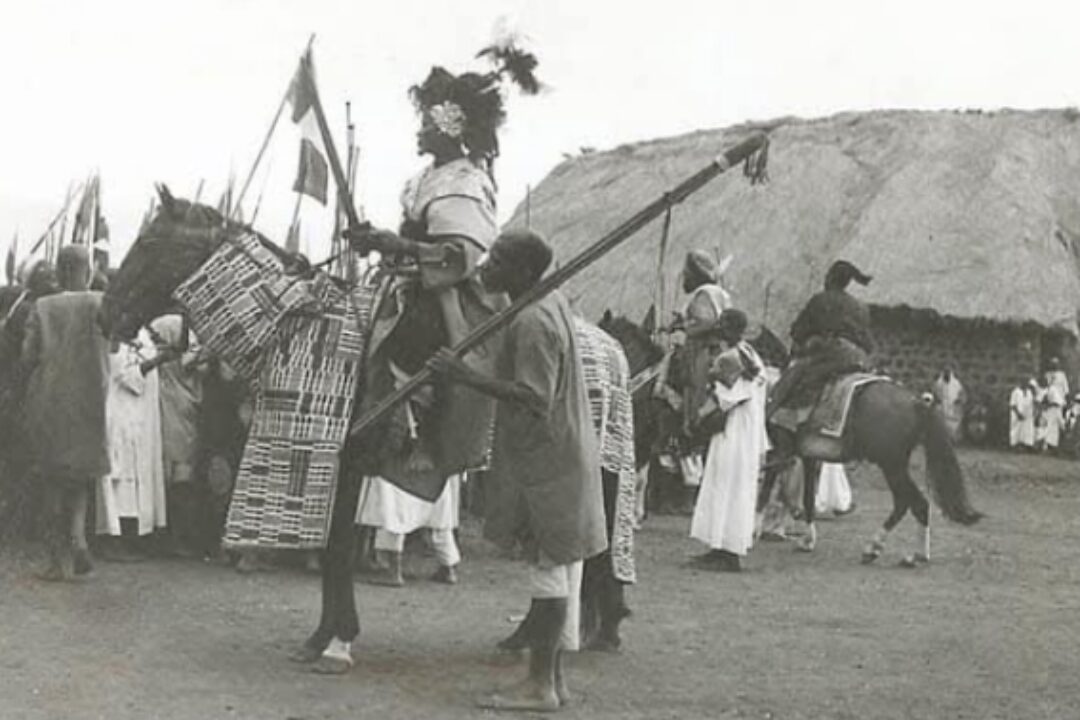
The Zabarma Chieftaincy of Kpando was established in 1904 by Shamsun Sorna I, who enskinned Sarki Garba Sayi (I) as the first Sarkin Zabarman (Chief) of Kpando. From the very beginning, the purpose of founding the chieftaincy was not only to create a ruler, but to build a stable traditional authority that could preserve the Zabarma identity in the Kpando area of Ghana.
Accordingly, the traditional institution was designed to preserve and govern the Zabarma community in Kpando, ensuring cultural continuity, social order, conflict management, and the protection of the community’s heritage, including traditional rites, and communal festivals.
In addition to being the founder of the chieftaincy, Shamsun Sorna I was also the biological father of Sarki Mumuni Sorna (II), the third chief. This biological relationship provided a foundational bloodline that later became central to the chieftaincy’s succession practices.


In other words, while the chieftaincy needed capable leadership at every stage, it also held a strong expectation that the founder’s lineage would remain connected to the throne. This connection was especially important in a period when communities faced migration pressures, inter-community disputes, and changing social arrangements, making continuity and legitimacy key.

The first Zabarma Chief of Kpando, Sarki Garba Sayi l, ascended the throne in 1904 and lasted for 42 years until his death in 1946. He was enskinned by Shamsun Sorna I (the founder of the Zabarma community in the area) in 1904.
His long reign was characterized by the consolidation of authority and the strengthening of customary institutions. It also created an environment where the successor relationship between founder’s line and the chiefship could be handled carefully when biological questions later arose.

After Shamsun Sorna I’s death in 1946, Garba Sayi (I) adopted Mumuni Sorna II as his son, recognizing him as the biological heir of the founder. Historically and according to history and tradition, Mumuni Sorna II lived with Garba Sayi (I) during this period as a son, meaning he was not only recognized in name but also trained within the chief’s household.
The narrative here establishes a clear significance and precedent, it created a framework in which chiefs of that time adopted the founder’s biological son to maintain the bloodline continuity on the Chiefdom, ensuring both legitimacy and practical leadership preparation.
The second Chief of Zabarma in Kpando after the death of Sarki Garba Sayi l in 1946, was Sarki Shuaibu Karma (II), who ruled for 31 years (1946–1977). During this phase, the chieftaincy continued operating under the principle that the spiritual and administrative foundation of the community must remain connected to the founder’s residence and lineage.
Thus, after the death of Garba Sayi (I) in 1946, with no biological sons, Sarki Shuaibu Karma (II) decided it was wise to continue his chieftaincy at Shamsun Sorna I’s house. By doing so, he established the founder’s residence as the spiritual and administrative center of the Zabarma Chieftaincy at Kpando.
Importantly, history established that Shamsun Sorna I took care of Shuaibu Karma (II), ensuring continuity and guidance of leadership from the founder’s line. In practical terms, this meant that leadership knowledge, customary expectations, and the proper performance of rites were transmitted within the founder’s household.
Whilst Mumuni Sorna II continued to live with Shuaibu II, he was automatically seen as an adopted son of Mumuni, and this was understood within the community’s tradition of safeguarding lineage continuity. In this system, adoption served as a powerful institutional tool, reinforcing the chieftaincy’s core requirement that the founder’s bloodline must be preserved even when biological heirs were absent or not immediately available.
THE ADOPTION SUCCESSION PATTERN
A unique feature of the Zabarma Chieftaincy is its adoption-based succession mechanism, which emerged due to the absence of biological children among the first two chiefs. Rather than viewing adoption as a weakness or exception, the Zabarma tradition treated adoption as a structured and respected method for maintaining political and spiritual legitimacy.
As a result, this succession pattern ensured that the founder’s bloodline was preserved and honoured through successive generations.
For example, when Garba Sayi (I) adopted Mumuni Sorna II, the act did not end with recognition, it enabled Mumuni Sorna II to learn governance and customary responsibilities within the chief’s environment.
Similarly, when Shuaibu Karma (II) continued leadership at Shamsun Sorna I’s house, the founder’s household became a training and authority hub. Over time, the community learned that succession decisions would prioritize continuity of lineage, the readiness of a successor, and the preservation of the founder’s spiritual foundation.
THE BIOLOGICAL HEIR ASCENDS
Sarki Mumuni Sorna (II), who ruled from (1977–1998), was born in Ghana on 11th February 1938 (per Ghanaian passport records). He was enskinned at the age of 39 years. He succeeded Shauaibu II after his death in 1977. His ascension illustrates how biological inheritance and adoption practices combined to create continuity of authority.
In addition, the biological son of Shamsun Sorna I (the founder) adopted into the chief’s structure through Garba Sayi (I) and later Shuaibu (II). Both predecessor chiefs lived with Mumuni Sorna II and, through successive adoption and household residence, prepared him as the heir. Historically, Mumuni Sorna (II) represents the convergence of the biological lineage (through Shamsun Sorna I) and the adoptive succession (through Garba Sayi I and Shuaibu II).
His ascension validated the adoption system as a legitimate and effective mechanism for chieftaincy continuity, because it proved that adoption could preserve both lineage memory and leadership capability at the same time.
THE REGENCY PERIOD
Sarki Tahiru Korda ruled for 25 years (1998–2023) as a regent Chief. His role was to serve as the interim ruler following the death of Mumuni Sorna (II) in 1998, maintaining stability and governance until the succession was resolved.
During a regency, the community relies heavily on continuity in ritual leadership, dispute handling, and administrative order. Therefore, the long regency period reflects the careful deliberation required to identify and prepare the rightful heir without breaking tradition.
The extended regency also suggests that king makers, elders, and custodians of tradition considered not only claimants, but also the readiness of candidates to uphold the founder’s spiritual and administrative legacy.
In traditional societies, such periods often include consultations, verification of lineage claims, and preparations for enskinment rituals—steps that cannot be rushed without risking internal misunderstanding or spiritual complications.
THE CURRENT CHIEF
After resolving the next bloodline successor, Sarki Mumuni Sorna III was accepted by the community and the king makers and was enskinned as the Chief in 2023 to date. He then became the fourth bloodline chief of Zabarma in Kpando with a ceremonial title, Sarki Dr. Abdul Rahman Dauda (IV).
This process indicates communal agreement and recognition of legitimacy, which are essential in maintaining respect for the throne.
The current chief, Sarki Mumuni Sorna III inherited the chieftaincy through matrilineal descent, a recognized tradition in many Ghanaian chieftaincy systems.
His mother was the biological child of Mumuni Sorna (II), making him the great-grandson of Shamsun Sorna I (founder) and the legitimate heir to the Zabarma throne. This matrilineal recognition demonstrates the flexibility and inclusivity of Zabarma chieftaincy traditions, where both maternal and paternal links can be considered legitimate routes to succession, depending on the accepted customary framework.
HISTORICAL GUIDELINES
Mumuni Sorna (II)’s date of birth (11/02/1938) is recorded on his Ghanaian passport, providing official verification of his age at ascension (39 years old in 1977). Such documentation strengthens the accuracy of the timeline and helps confirm that traditional records and documentary records align.
The adoption of Mumuni Sorna II by both Garba Sayi (I) and Shuaibu (II) was not merely personal but institutional, designed to preserve the founder’s bloodline within the chieftaincy structure.
In practical terms, this ensured that the successor would be raised with the right knowledge of customs, required etiquette, and leadership responsibilities.
Sarki Shuaibu Karma (II) started his chieftaincy at Shamsun Sorna I’s house, establishing the founder’s residence as the spiritual and administrative center of the Zabarma Chieftaincy. Shamsun Sorna I took care of Shuaibu Karma (II), ensuring continuity of leadership from the founder’s line. Consequently, the place of enskinment and residence became more than geography, it became a symbol of spiritual continuity and governance legitimacy.
The current chief’s succession through his mother reflects the flexibility and inclusivity of Zabarma chieftaincy traditions, which recognize both paternal and maternal lines for legitimate succession.
It is good to note that while specific dates for early 20th-century events are approximated based on oral tradition and community records, the succession pattern and biological relationships are well-documented and consistently transmitted.
The phrase ‘lived with’ indicates that Mumuni Sorna II was not merely ceremonially adopted but physically resided with each chief, receiving training, guidance, and preparation for future leadership.
This method of preparation helped the future chief understand governance challenges, ritual duties, and the expectations of the community before enskinment.
The continuous preservation of Shamsun Sorna I’s biological line through adoption and maternal inheritance demonstrates the chieftaincy’s commitment to honouring its origins while adapting to practical circumstances.
Therefore, Zabarma tradition shows that lineage continuity can be protected even when biological inheritance alone cannot supply a direct successor.
CONCLUSION
The Zabarma Chieftaincy of Kpando stands as a remarkable example of adaptive succession mechanisms in traditional African governance.
Through adoption, biological lineage preservation, and maternal inheritance, the chieftaincy has maintained continuous governance for over 120 years (1904–present).
This long continuity reflects not only careful leadership transitions, but also the community’s commitment to protecting legitimacy, spiritual authority, and cultural memory.
Moreover, the chieftaincy institution remains a vital custodian of Zabarma cultural heritage, community cohesion, and historical memory in the Kpando region of Ghana. As custodians of tradition, the chiefs and king makers help ensure that communal values are preserved across generations, and that governance remains anchored in recognized customary principles.
This document serves as an official historical record for public education, archival preservation, and transmission to future generations. The succession pattern documented herein reflects both the resilience of Zabarma traditions and their capacity to evolve while maintaining core principles of lineage, honour, and community service.
Note: Document was compiled for public history education and archival preservation of Zabarma community in Kpando, Ghana. It was based on verified oral traditions and documentary records.
Author :Sarki Dr. Abdul Rahman Dauda IV,(Sarki Zabarma of Kpando IV)