By:Isaac Amoah
“It’s very pathetic and a threat to our livelihoods to spend a lot of money and sleepless nights in search of fishes only to return home with a few, or an empty net.
“The most frustrating aspect in the fishing business in recent years is that usually when you cast nets expecting to catch fish, you rather drag the nets from the sea full of polythene bags and other plastic wastes. When we started fishing, we only needed to move a short distance on the sea and we could come back with plenty of different species of fishes. Unfortunately, the situation has changed in recent times. The nets rather catch rubbers or plastic wastes.


“We have no alternative jobs to help us pay our children’s school fees, including other expenses. Due to the declining fish stocks, the fishing business is now “fish for mouth”, for which reason something urgent must be done about it for us!”
The above is the summary sentiments of a 36-year-old Kwesi Afadzi, a fisherman with 20 years’ experience in fishing.
Some of his colleague fishermen at Winneba in the Central Region of Ghana, such as Kofi Acquah, 33; Kodjo Ekumah aka John Ayi Mensah, 48; Ekow Budu, 49; Kwame Obeng, 62, shared their frustrations and helpless experiences at the seaside on Tuesday, 5th May 2026, during a working visit.


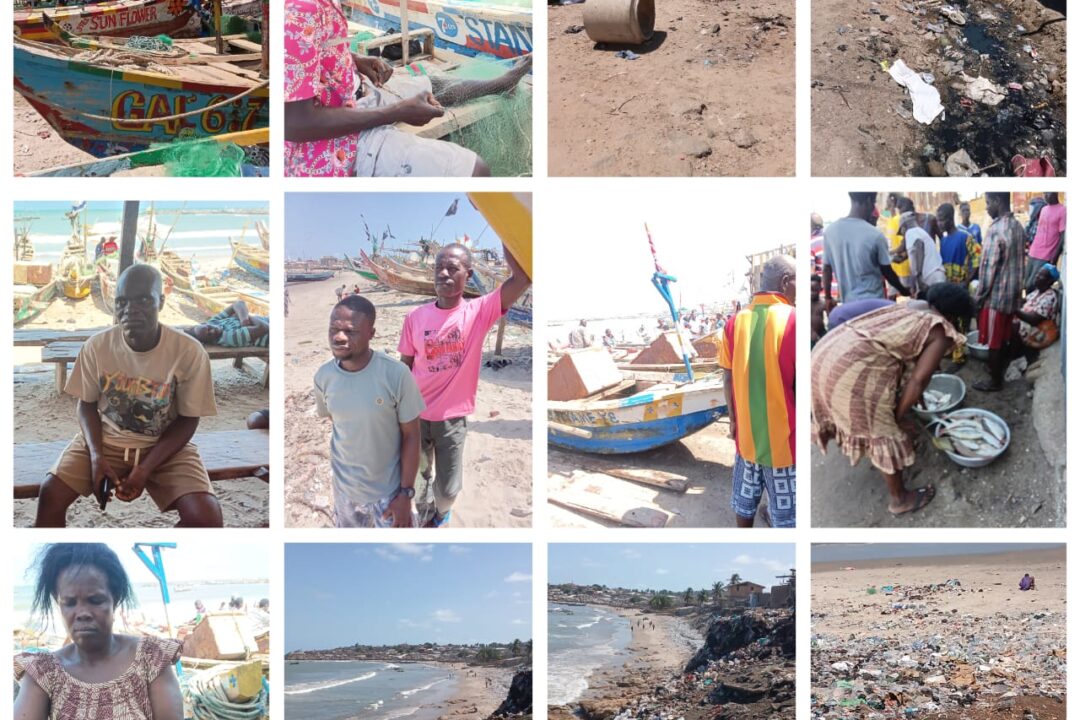
Some scenes from Winneba sea area
Evidence of impact of plastic pollution and industrial contamination on marine ecosystem
Personal observations
A research conducted around the coastal areas, especially at Winneba, has established that fishers are currently at the mercy of plastic pollution and industrial contamination which calls for urgent action to arrest the situation so as to protect the livelihoods of millions of people in the fisheries value chain.
The indiscriminate dumping of plastic and industrial wastes (rubbers and polythene bags), open defecation, as well as the dumping of all kinds of waste, have become the order of the day. This is backed by pictorial evidence.

Some scenes of open defecation from few meters from where Madam Aku Suaman and colleagues fish sellers always meet fishermen to buy their catch from the sea
Interestingly, some fishers and community members admitted complicity, though they were prepared to support any initiative to free the sea from contamination.
They indicated that the continuous pollution of the sea with plastic and industrial wastes as a result of daily human activities is currently contributing to the declining fish stocks, as they themselves can testify. According to them, it is sad that their nets continue to catch polythene bags and other plastic wastes from the sea instead of fish.
The above narration was corroborated by some female fish sellers who buy their fishes directly from the fishers at the seaside. According to them, the persistent dumping of rubbish and other plastic wastes is having a negative impact on their livelihoods.

Some scenes around Winneba sea
With frustration and dejection written on their faces during an interview, the fishers and other community members called for urgent action to halt the continuous dumping of refuse, plastic wastes and all manner of things that contribute to the pollution of the sea.
The call for urgent action requires the collaborative efforts of all stakeholders. This call by the fishers comes at a time when the Ghana Agricultural and Rural Development Journalists Association (GARDJA), in partnership with Earth Journalism Network (EJN), recently launched a project dubbed “Save our seas”.
The project aims to support high-quality journalism that raises awareness, informs public debate, and promotes accountability regarding marine conservation, sustainable fisheries, and ocean governance in Ghana.
Admission of complicity of plastic pollution by some fishers
Kwesi Afadzi, a 36-year-old fisherman with over 20 years’ experience in the business, said, “We’re all bread winners and others depend on us. We usually come to spend some days on fishing expeditions and the nets come back from the sea with virtually nothing. What is even killing our spirit is that many times either the nets are full of plastic wastes or are destroyed by piled up wastes in the sea.”
He continued, “I started fishing at age 16, and I’m now 36 (almost 20 years in this business). I remember that time there was no proliferation of rubbers and other plastic wastes in the system. It was easy to go a short distance and catch abundant fishes. Unfortunately, the situation has changed now.”
He added, “Sometime back, when we (fishermen) went to the sea, we always disposed of polythene bags and other plastic bowls we ate from into the sea, and we didn’t know it would affect our business one day. Besides, community members around the sea always dump anything into it. I’m, therefore, calling on government officials to do something about this. If possible, they should ban the use of polythene and plastic rubbers.”
Kofi Acquah, a 23-year-old fisherman, shared similar concerns that something urgent needed to be done to rescue the continuous pollution of the sea because they’ve all realised that it is not easy these days to catch enough fishes.
Although he is not a health expert, he suspects there must be health implications for the way rubbish and plastics are hurled into the sea…
“A collective effort is needed to stop plastic and industrial contamination,” he added.
A fisherman, Kodjo Ekumah aka John Ayi Mensah, 48, a native of Winneba, also admitted that the fishers and other stakeholders in the fisheries value chain, especially around the sea, are complicit in the indiscriminate dumping of refuse or rubbish into the sea.
The other culprits are community members who usually sneak out at dawn to dump their refuse full of plastic bottles, including waste from different drainage directed into the sea as final destination.
He said, “I think that it’s time for us all to stop this unhealthy practice because it’s now difficult to catch fish from the sea. Whenever there is a heavy rain, you see all manner of plastic wastes from the community dropping into the sea. Besides, we need to do something to protect our livelihood; we also need to remember that we also eat or consume some of the caught fish from the same sea we are polluting.”
“We also ought to think about those who consume fish across the country, including our family members, in order to prevent any health implications,” he stressed.
Concerns raised about open defecation on the seashore by adults and children
Some fishermen at Winneba, namely Ekow Budu, Opanin Kwaw Dokor, 49, with 29 years’ experience in fishing; Kwame Obeng, 62, with 40 years’ experience in fishing; and Kojo Gyansah, 54, a boat owner with 34 years’ experience in the business, also expressed their concerns about how the sea had been engulfed by plastic wastes, polythene bags and all kinds of rubbish.
Besides, they voiced their displeasure at the persistent open defecation by adults and children, involving the fishermen themselves and community members, though there are nearby public toilet facilities in the sea areas.
A call for a ban on plastic rubbers, disposable bowls, etc
They, therefore, called for an outright ban on the use of plastic rubbers, disposable bowls, and polythene bags to help save the sea from the constant pollution of plastic and industrial waste materials.
A call for the formation of taskforce to tackle issues
With regard to open defecation along or around the sea, Opanin Kwaw Obeng and Mr Kwame Obeng called for the setting up of a taskforce to protect the sea from open defecation and the dumping of wastes.
Reduced fish stocks resulting in high prices on the market
A 38-year-old fish seller, Madam Aku Suaman, decried the high prices of fishes on the market, resulting from a decline in fish stocks. She said, “I’ve been coming here to buy fish from the fishermen for the past five years. I can tell you that there has been a decline in fish stock. The fishermen always come back from the sea complaining about ‘low catch’ and their nets rather catching plastic wastes. This is also causing high fish prices on the market.”
Appeal for Zoomlion sweepers in sea areas, nearby communities
Madam Aku Suaman has, therefore, called on the government to bring back Zoomlion sweepers around sea areas across the country, especially at Winneba.
She stressed, “I’m appealing to the government to bring back Zoomlion sweepers along sea areas and beaches across the country to help keep these places neat and hygienic.”
“I’ve been told the sweepers abandoned their work because they were not being paid after the introduction of Zoomlion during Mr Kufuor’s tenure as president. Nonetheless, no one should be allowed to defecate along sea areas,” she added.
Public toilet verses open defecation on seashores
Speaking to Mr. Emmanuel Cobbinah Gyan, aka Ogana, the caretaker of Akrama Ano Public Toilet which is just about five minutes walk from the sea, he said before the facility was put up some people were doing open defecation, but they have stopped after the opening of the toilet facility which charges GH¢1. “However, many have also vowed not to pay the GH¢1 to use the facility. According to them, they enjoy fresh air when they defecate at the seaside,” he indicated.
He indicated that the authorities had tried to stop open defecation in the sea area but the practice still persists. He said he believes there are lots of health implications for such practices since everything ends up in the sea.
“Since we consume fish from the same sea, it has serious health implications. It can result in cholera and other waterborne diseases. The authorities should gather the courage and ban such activities completely,” he added.
A concerned community youth member raises red flag
A 16-year-old sobolo seller along the sea area at Winneba, Anna Abe-Ikuu, has also expressed worry that whenever she goes to the sea area to sell, she witnesses some unhealthy practices such as dumping of dirty water, rubbish and plastic wastes into the sea, including open defecation.
She said, “Normally, when I come here, I see there are lots of rubbish around…I think the plastic and rubbish we see are as a result of regular disposal of refuse and plastic wastes into the sea. Sometimes, I see people carrying dirty water in buckets and pouring them into the sea. Some people swim and embark on fishing expedition from the same polluted sea.”
Fishermen must lead the awareness creation to save their livelihood and others
To fishermen, Anna Abe-Ikuu said, “I think the fishermen are supposed to play a key role to stop the pollution of the sea because they’re the ones that go to the sea and they’re the ones that actually see what they catch from the sea. I’ve been told that when they go to the sea, they catch plastic wastes and polythene bags instead of fish. They (fishermen) are the ones that need to raise these concerns because they go to the sea for fishing.”
A call on health personnel and government officials to act now on plastic pollution and industrial contamination on marine ecosystem
To health professionals and government officials, the 16-year-old sobolo seller said, “Please you people are aware of the importance of the fishing industry, especially in terms of the revenue it contributes to the Ghanaian economy. I’m pleading with you to, at least, raise awareness about the health implications of the persistent pollution of the sea with plastic wastes, including open defecation.”
“Come and talk to the fishermen and community members. Through your education, I strongly believe that, over time, they’ll put a stop to plastic pollution and open defecation,” she added.
Ignorance on the part of some fishermen
Mr. Stephen Mensah, a 45-year-old fisherman with 30 years’ experience, who says he enjoys defecating around the sea because of fresh air, strongly disagrees with the assertion that open defecation and dumping of plastic waste and polythene bags into the sea have or will have any public health issue.
“…I’ve been living here in my parents’ house and have been in the fishing business across many fishing areas. Everywhere you go, it is the same thing. Dumping of plastic wastes, open defecation and dropping of refuse into the sea are common. Even if we’re compelled to use the public toilet, we’ll defecate openly in the night… As for me, I don’t agree with people that the pollution of the sea has health effects on the fish we catch,” he said out of sheer ignorance.
Importance of fisheries sector
Kofi Agbogah, Executive Director, HenMponano in a recent three-day virtual training organised by Journalism Earth Network (EJN) revealed the importance of the fisheries sector with the statistics below:
Ghana’s fisheries sector contributes 1% to GDP, provides direct employment to over 100,000 fishers, indirect employment to three million workforce along the value chain, provides 50% of animal protein (cheapest source of protein) and 70% of the fish landings are done by artisanal fishermen (Anchovies, Sardinella, Mackerel).
Ghana’s 30 X 30 perspective
Oceans and coastal ecosystems are vital to food security, livelihoods, biodiversity conservation, and economic development. In Ghana, thousands of coastal communities depend on fisheries and marine resources for their livelihoods. However, marine ecosystems are under increasing pressure due to overfishing, illegal fishing practices, marine pollution, coastal degradation, and climate change.
Globally, more than 190 countries have committed to protecting 30% of the world’s land and ocean areas by 2030 under the 30×30 target of the Global Biodiversity Framework.
Expert perspective and the way forward
Professor Berchie Asiedu, the acting Deputy Executive Director Technical, Fisheries Commission and a member of the National Blue Economy Strategy Technical Committee and National Committee on Aquaculture, at the recent presentation during a special training workshop for journalists on effective marine conservation reporting organised by Ghana Agricultural and Rural Development Journalists Association (GARDJA) funded by EJN, emphasised that our nation’s identity is inevitably linked to the Atlantic Ocean.
From the active shores of Keta to the vibrant landing beaches of Half Assini (about 550 km coastal length), the ocean is not merely a resource but also our lifeblood. It provides food security for millions, sustains over 14,000 fishing vessels, and supports the livelihoods of approximately 10% of our population.
Expert admission of the concerns
However, Prof. Asiedu said our marine environment faces unprecedented “tripartite threats”: climate change, plastic pollution and illegal, unreported, and unregulated (IUU) fishing.
“Today, I stand before you to outline how the Ministry of Fisheries and Aquaculture (MoFA) and the Fisheries Commission are leading the charge to protect this heritage and meet the ambitious,” he said.
“30×30” global target
The 30×30 Commitment: From Vision to Reality
According to Professor Berchie Asiedu, Ghana is proudly committed to the Kunming-Montreal Global Biodiversity Framework, during the fifteenth meeting of the Conference of the Parties (COP 15) from 7th to 19th December 2022 in Montreal, Canada, which mandates the protection of 30% of our lands and oceans by 2030.
He said, “For a maritime nation like ours, this is more than a pledge; it is a survival strategy
To achieve this, the Fisheries Commission, in collaboration with the Ministry, has transitioned from traditional management to a spatial-protection model:
Establishment of Marine Protected Areas (MPAs): We are currently moving beyond the pilot phase of the Greater Cape Three Points Initiative. The Commission is working to designate Ghana’s first formal network of MPAs, ensuring that protected areas are legally shielded from industrial extraction.
The Sustainable Ocean Plan (SOP): Launched in late 2025, the SOP serves as our roadmap for 100% sustainable management of our Exclusive Economic Zone (EEZ). It integrates fisheries management with marine spatial planning, ensuring that conservation and economic growth coexist.