Skip to content
Menu
Menu

TI – Ghana trains 30 journalists in defence & security reporting & calls for people-focused approach development journalism


By:Isaac Amoah

As part of equipping journalists and media practitioners with a working understanding of defence integrity as a distinct field of governance and accountability, including the risk factors, institutions, and oversight mechanisms that define it, Transparency International-Ghana has organised a day’s workshop for media professionals in the Ashanti region.

Participants were drawn primarily from print, broadcast, and online media houses operating in Kumasi, the Ashanti Regional Capital.


tntnewspapergh.com


The workshop, which was held d on Thursday, 30th July, 2026, at MAC BENNETT HOTEL, near Kotoko Training Park, Adako ,introduced participants to Transparency International’s Government Defence Integrity Index and related assessment tools and demonstrated how these tools can inform investigative and analytical reporting on Ghana’s defence sector.

Some scenes from the workshop

The training also equipped participants to identify concrete, responsible story angles arising from defence integrity issues relevant to Ghana and to build a lasting network of media contacts equipped and willing to sustain reporting on this theme beyond the training.


In her opening remarks, the Executive Director of Transparency International-Ghana, Mrs. Mary A. Addah disclosed that her outfit, through its Defence and Security unit based in the UK, has, over the past decade, built a substantial body of work on defence and security governance, contributing to the broader efforts of the Transparency International movement to reduce corruption risk in defence institutions worldwide.


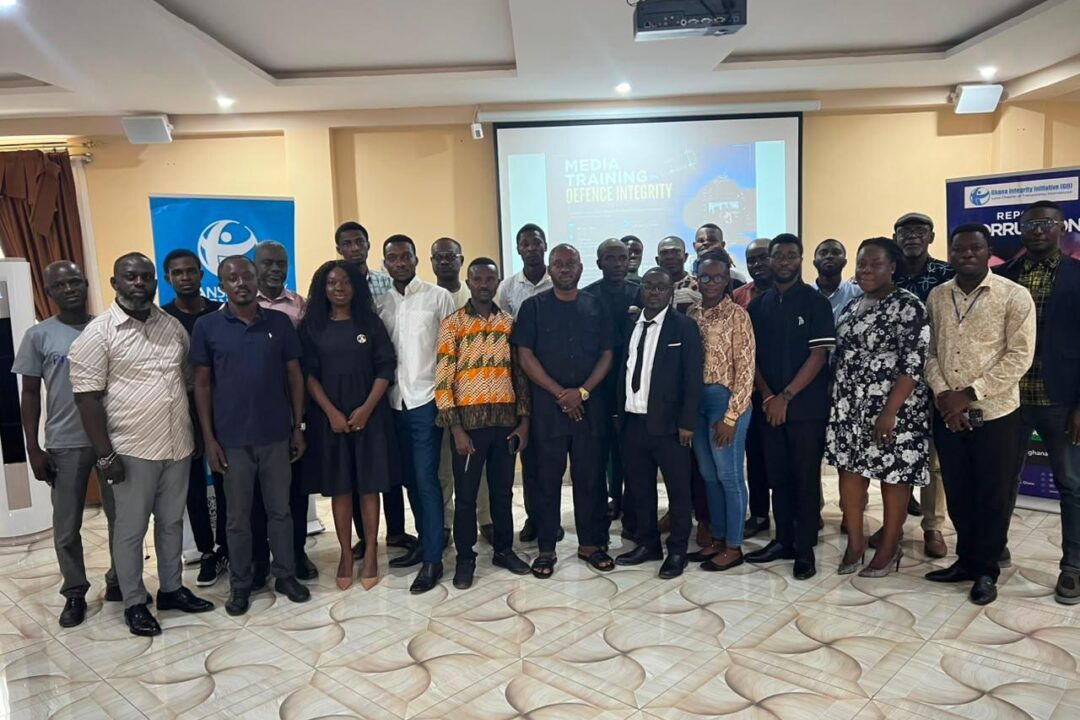
Participants in a group photograph

According to her, this work recognises that the defence and security sector, by virtue of its secrecy provisions, limited parliamentary oversight, and high-value procurement, remains one of the most corruption-prone areas of public administration and one of the least scrutinised by citizens and the media alike.

“In Ghana, as in many countries, defence institutions rarely feature in public-interest reporting, not for want of significance but for want of the specialised knowledge required to report on them competently and responsibly.The media occupies a uniquely powerful position in advancing defence integrity. Journalists shape public understanding of how public institutions are governed, how public funds allocated to these institutions are spent, and whether oversight mechanisms are functioning as intended. ”

The Executive Director, noted that,yet defence reporting demands a distinct set of competencies: an understanding of the legitimate boundaries of national security confidentiality, familiarity with procurement and budgetary processes particular to the sector, and the judgement to pursue accountability reporting without inadvertently compromising operational security.
According to her, without this grounding, media coverage of the defence sector tends towards either silence or sensationalism, neither of which serves the public interest.

Against this background, Transparency International Ghana, with technical support from the Transparency International Defence and Security Unit and funding from the Dutch Foreign Affairs, decided to hold a one-day media training in Kumasi.

The training directly addresses a recurring gap identified in the organisation’s engagement with journalists and media houses in Ghana: a willingness to report on governance and accountability issues, coupled with limited exposure to the specific frameworks, indicators, and vocabulary that make defence integrity reporting rigorous and credible,determining whether defence-related story pitches are taken forward for publication or broadcast.

The training was therefore structured as an interactive, single-day workshop rather than a lecture-style session. Dr Michael Ofori-Mensah, Research Lead at Transparency International Defence & Security, served as the resource person, with facilitation by Michael Boadi, Fundraising Manager at Transparency International Ghana.

The training drew on TI-DS’s global research and comparative experience in training journalists. on defence governance in other contexts. They, therefore, combined the format of substantive presentations on defence integrity concepts and Ghana’s specific institutional landscape with facilitated discussion, case study review, and small-group exercises in which participants work through sample datasets or documents to practise identifying red flags and framing accountability angles.

Mr Michael Boadi, Fundraising Manager at Transparency International Ghana, made a presentation on the topic “Navigating National Security, Press Freedom, and Public Interest: The Role of the Media in Defence and Security Reporting.”

Mr Michael Boadi in an interview with journalists after training

He encouraged media professionals to develop an interest in specialisation in defence and security reporting.

According to him, the media need more training in the area because it’s a specialist field.

Mr Boadi believes that the media and military can work together instead of seeing each other as enemies.

According to him, these methods help ensure the public gets accurate information while operational security is maintained.

He therefore proposed that there should be regular official briefings, joint training for journalists and soldiers, mutual understanding of limits, embedded reporting with agreed rules, and declared media a “strategic partner.”

Other methods he believes can help strengthen the partnership include opening doors for fact-checking and encouraging balanced reporting, as well as holding regular briefings.

Mr Michael Boadi also called for a people-focused approach to development journalism.

According to him, this approach shifts the focus from just “what happened” to “how does this affect people?”It encourages reporters to look at the human side of security issues, which helps build trust and understanding.”

He stressed that development journalism puts people first by focusing on human safety, investigating policy impacts on communities, encouraging conversation and inclusivity, and using facts and evidence for storytelling.


TI – Ghana trains 30 journalists in defence & security reporting & calls for people-focused approach development journalism


By:Isaac Amoah

As part of equipping journalists and media practitioners with a working understanding of defence integrity as a distinct field of governance and accountability, including the risk factors, institutions, and oversight mechanisms that define it, Transparency International-Ghana has organised a day’s workshop for media professionals in the Ashanti region.

Participants were drawn primarily from print, broadcast, and online media houses operating in Kumasi, the Ashanti Regional Capital.


tntnewspapergh.com


The workshop, which was held d on Thursday, 30th July, 2026, at MAC BENNETT HOTEL, near Kotoko Training Park, Adako ,introduced participants to Transparency International’s Government Defence Integrity Index and related assessment tools and demonstrated how these tools can inform investigative and analytical reporting on Ghana’s defence sector.

Some scenes from the workshop

The training also equipped participants to identify concrete, responsible story angles arising from defence integrity issues relevant to Ghana and to build a lasting network of media contacts equipped and willing to sustain reporting on this theme beyond the training.


In her opening remarks, the Executive Director of Transparency International-Ghana, Mrs. Mary A. Addah disclosed that her outfit, through its Defence and Security unit based in the UK, has, over the past decade, built a substantial body of work on defence and security governance, contributing to the broader efforts of the Transparency International movement to reduce corruption risk in defence institutions worldwide.


Participants in a group photograph

According to her, this work recognises that the defence and security sector, by virtue of its secrecy provisions, limited parliamentary oversight, and high-value procurement, remains one of the most corruption-prone areas of public administration and one of the least scrutinised by citizens and the media alike.

“In Ghana, as in many countries, defence institutions rarely feature in public-interest reporting, not for want of significance but for want of the specialised knowledge required to report on them competently and responsibly.The media occupies a uniquely powerful position in advancing defence integrity. Journalists shape public understanding of how public institutions are governed, how public funds allocated to these institutions are spent, and whether oversight mechanisms are functioning as intended. ”

The Executive Director, noted that,yet defence reporting demands a distinct set of competencies: an understanding of the legitimate boundaries of national security confidentiality, familiarity with procurement and budgetary processes particular to the sector, and the judgement to pursue accountability reporting without inadvertently compromising operational security.
According to her, without this grounding, media coverage of the defence sector tends towards either silence or sensationalism, neither of which serves the public interest.

Against this background, Transparency International Ghana, with technical support from the Transparency International Defence and Security Unit and funding from the Dutch Foreign Affairs, decided to hold a one-day media training in Kumasi.

The training directly addresses a recurring gap identified in the organisation’s engagement with journalists and media houses in Ghana: a willingness to report on governance and accountability issues, coupled with limited exposure to the specific frameworks, indicators, and vocabulary that make defence integrity reporting rigorous and credible,determining whether defence-related story pitches are taken forward for publication or broadcast.

The training was therefore structured as an interactive, single-day workshop rather than a lecture-style session. Dr Michael Ofori-Mensah, Research Lead at Transparency International Defence & Security, served as the resource person, with facilitation by Michael Boadi, Fundraising Manager at Transparency International Ghana.

The training drew on TI-DS’s global research and comparative experience in training journalists. on defence governance in other contexts. They, therefore, combined the format of substantive presentations on defence integrity concepts and Ghana’s specific institutional landscape with facilitated discussion, case study review, and small-group exercises in which participants work through sample datasets or documents to practise identifying red flags and framing accountability angles.

Mr Michael Boadi, Fundraising Manager at Transparency International Ghana, made a presentation on the topic “Navigating National Security, Press Freedom, and Public Interest: The Role of the Media in Defence and Security Reporting.”

Mr Michael Boadi in an interview with journalists after training

He encouraged media professionals to develop an interest in specialisation in defence and security reporting.

According to him, the media need more training in the area because it’s a specialist field.

Mr Boadi believes that the media and military can work together instead of seeing each other as enemies.

According to him, these methods help ensure the public gets accurate information while operational security is maintained.

He therefore proposed that there should be regular official briefings, joint training for journalists and soldiers, mutual understanding of limits, embedded reporting with agreed rules, and declared media a “strategic partner.”

Other methods he believes can help strengthen the partnership include opening doors for fact-checking and encouraging balanced reporting, as well as holding regular briefings.

Mr Michael Boadi also called for a people-focused approach to development journalism.

According to him, this approach shifts the focus from just “what happened” to “how does this affect people?”It encourages reporters to look at the human side of security issues, which helps build trust and understanding.”

He stressed that development journalism puts people first by focusing on human safety, investigating policy impacts on communities, encouraging conversation and inclusivity, and using facts and evidence for storytelling.




Related Stories
Popular Stories