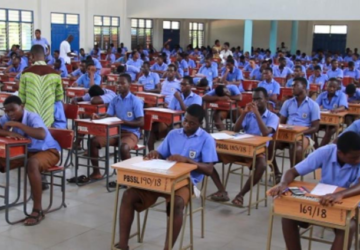
The Ghana Education Service has credited the integrity of the 2025 WASSCE results to strengthened supervision and adherence to strict examination protocols nationwide.
According to a statement issued on Monday, December 1, the Ministry of Education and GES issued a firm directive before the exams, warning that any teacher or official involved in malpractice would face sanctions. This, GES said, was “rigorously enforced.”
The heightened measures, including increased vigilance and stronger monitoring at examination centres, led to “the apprehension of some students and staff who would have engaged in examination malpractices.”
GES insists that the results demonstrate a positive shift towards restoring public confidence in national examinations.
“The outcome is a direct demonstration of the trend towards restoring the integrity of the examination process,” the statement noted.
With Ghana transitioning from the Ghana-only WASSCE to the international version in May/June 2026, GES has encouraged students to take preparation seriously.
“Management of GES will not compromise the integrity of examinations,” it reaffirmed.Source: Clara Seshie
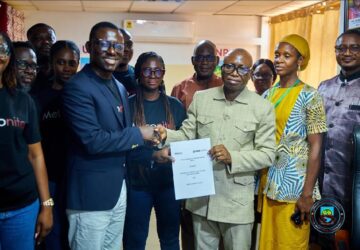
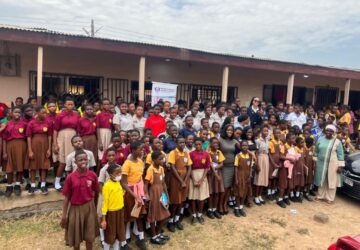
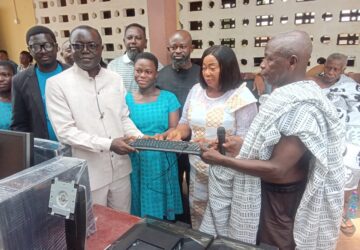
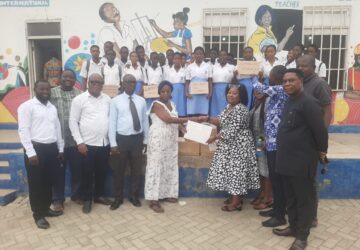
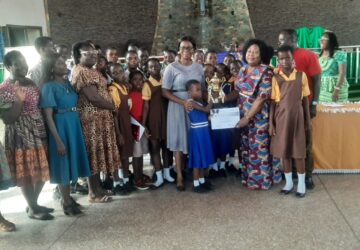
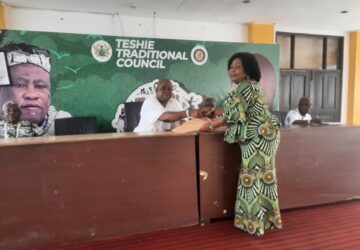
The Paramount Chief of the Nungua traditional area, His Royal Highness (Prof) Oboade Notse Odaifio Welentsi III, has presented GH10,000 to a JHS teacher for promoting the teaching and learning of the Ga language and culture in schools in the Krowor Municipality.
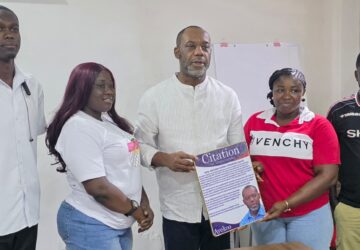
The recipient of the cash is a JHS Ga Language teacher at the Nungua SDA C Basic School, Miss Faustina Addoteye.
Nii Bortey Okplen Dzalesane ii , Oblantai Mantse (left) presenting the cash to Miss Faustina on behalf of the Paramount Chief during the event at Nungua
Part of the amount was for the procurement of a new laptop to help her continue researching and teaching the Language, while the rest served as a motivation for the frantic effort she was making towards the teaching and learning of the Ga culture in the Municipality.
The Paramount Chief made the presentation during the maiden Krowor Municipal Teacher Prize held at Nungua on Thursday.
The event saw some deserving teachers and other education workers being honoured for their dedication and efforts towards the promotion of education in the Krowor Municipality and the rest of the country.
Oboade Notse Odaifio Welentsi III promised to continue supporting teachers and other institutions which were ready to promote the Ga culture.
He called for the sustenance of the peace prevailing in the area for the people to continue with their businesses.
The recipient, Miss Faustina Addoteye, was full of praise for the honour done her as she pledged to continue working very hard towards the promotion of the Ga culture.
The Municipal Director of Education for Krowor, Azeriya G. Ayerega, commended the various award winners for the roles which keep promoting the development of education in the Municipality to keep the good work, reminding those who could not win to continue working hard so they could also win in future.
The Municipal Director of Education eulogised the various sponsors for their contribution towards the awards and pledged to continue working hard to ensure that the standard of education in the Municipality and the rest of the country improved.
The Greater Accra Regional Director of Education, Mrs Hajia Katumi Natogma Attah, congratulated all the award winners and urged them to let the awards spur them on to work harder since they did not win the awards on a silver platter.
She urged the recipient not to be complacent with the honour done to them and continue to work hard for the good and continuous promotion of education in the Municipality and the rest of the country.
Background
The extinction of indigenous languages is a global phenomenon which threatens many countries, including Ghana.
The presentation of the cash as a motivation in the form of an award to the best teacher for the Ga language in the Krowo Municipality was one of the ways by which indigenous languages such as Ga could be protected from extinction.
It is based on this that the gesture by the Paromunt Chief, therefore, was not only worth commending but also worth emulating by other communities for the protection and sustenance of such Languages.
By:Felix A.Baidoo
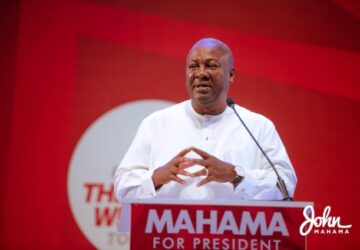
President John Dramani Mahama has received 10 petitions for the removal of two heads of public institutions and two deputies appointed under Article 70 of the Constitution.
The institutions are the Electoral Commission (EC) and the Office of the Special Prosecutor (SP).
Seven petitions were filed against the Chairperson of the EC, Jean Mensa, and her two deputies, Dr Bossman Eric Asare, who is in charge of Corporate, and Samuel Tettey, in charge of Operations.
Three other petitions are against the removal of the SP, Kissi Agyebeng.
Checks by Graphic Online’s Emmanuel Ebo Hawkson indicate that the various petitions have been forwarded to the Chief Justice, Justice Paul Baffoe-Bonnie.
Article 70(2) of the Constitution states that “The President shall, acting on the advice of the Council of State, appoint the Chairman, Deputy Chairmen and other members of the Electoral Commission.”
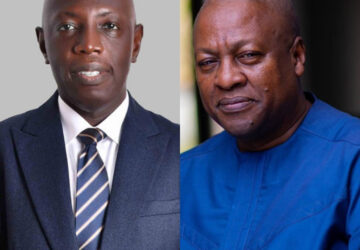
Mrs.Jean Mensah and Kissi Agyebeng
The Chairperson of the EC and the deputies have the same conditions of service as those of Justices of the superior courts — the Supreme Court, the Court of Appeal and the High Court — and so are their removal processes.
While the Chairperson of the EC has the same terms and conditions of service as a Justice of the Court of Appeal, the two Deputy Chairmen of the Commission have the same terms and conditions of service as are applicable to a Justice of the High Court.
Removal of EC chair
According to Article 146 of the 1992 Constitution, a Justice of the Superior Court or a Chairman of the Regional Tribunal shall not be removed from office except for stated misbehaviour or incompetence or on the ground of inability to perform the functions of his office arising from infirmity of body or mind.
The second clause provides that a Justice of the Superior Court of Judicature may only be removed in accordance with the procedure specified in Article 146(3).
“If the President receives a petition for the removal of a Justice of a Superior Court other than the Chief Justice or for the removal of the Chairman of a Regional Tribunal, he shall refer the petition to the Chief Justice, who shall determine whether there is a prima facie case.
“Where the Chief Justice decides that there is a prima facie case, he shall set up a committee consisting of three Justices of the Superior Courts or Chairmen of the Regional Tribunals or both, appointed by the Judicial Council and two other persons who are not members of the Council of State, nor members of Parliament, nor lawyers, and who shall be appointed by the Chief Justice on the advice of the Council of State.
It also provides that the committee appointed shall investigate the complaint and shall make its recommendations to the Chief Justice, who shall forward it to the President.
Article 146 also provides that all proceedings under the article shall be held in camera, and the Justice or Chairman against whom the petition is made is entitled to be heard in his defence by himself or by a lawyer or other expert of his choice.
“The President shall, in each case, act in accordance with the recommendations of the committee,” clause nine of the same article further provides.
Special Prosecutor
Section 15 of the Office of the Special Prosecutor Act, 2017 (Act 959) deals with the removal of the SP, with timelines.
Similar to that of the EC, the SP “shall not be removed from office except for (a) stated misbehaviour or incompetence; (b) incapacity to perform the functions of the Office by reason of infirmity of body or mind; (c) wilful violation of the Official Oath or Oath of Secrecy; (d) conduct which (i) brings or is likely to bring the Office of the Special Prosecutor into disrepute, ridicule or contempt; or(ii) is prejudicial or inimical to the economy or security of the State.
A person who seeks to remove the SP from office must submit a petition to the President, who must, within seven days, refer the petition to the Chief Justice,e who shall, within 30 days, determine whether there is a prima facie case.
Where a prima facie case is determined, the CJ shall, within 14 days, set up a committee similar to that of the removal of any of the heads of constitutional bodies appointed by the President.
The committee is duty-bound to investigate the matter within 90 days and make its recommendation to the President through the Chief Justice.
The President then has no choice but enjoined to act in accordance with the recommendations of the committee.Source:graphiconline.com
In the pursuit of national development, education remains a central pillar.
Among the many subjects taught in schools, Social Studies stands out as uniquely essential due to its broad, multidisciplinary nature and its direct relevance to everyday life. Drawing from history, geography, civics, economics and sociology, Social Studies provides a comprehensive understanding of how societies operate, how decisions are made, and how progress is achieved.
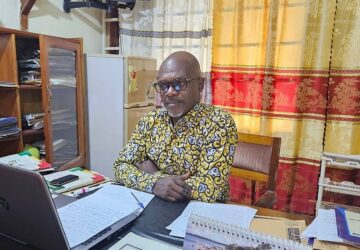
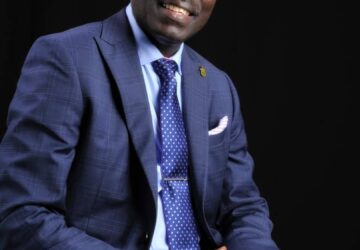
Mr.George Akom
Through this subject, citizens gain knowledge of their rights, responsibilities and civic duties, enabling them to understand the processes that keep a nation functioning. Social Studies deepens appreciation for the constitution, democratic governance, and the role of institutions, ensuring that citizens become active participants rather than passive observers.
It also equips learners with economic literacy, helping them understand national resources, trade, taxation, budgeting, and economic development strategies. Such knowledge empowers citizens to make informed choices that positively influence national prosperity.
Furthermore, Social Studies promotes cultural understanding and social cohesion, strengthening unity in a diverse nation.
By exploring various cultural practices, beliefs and histories, learners appreciate national diversity and develop tolerance, respect, and cooperation, qualities necessary for peace building and national stability. No country can make meaningful progress without unity and social harmony, and Social Studies provides the foundation for both.
However, despite its importance, Social Studies faces several challenges that hinder its effectiveness.
One major cause is the negative attitude many students hold toward the subject, often seeing it as too easy or less valuable than science- or math-based subjects.
This leads to a lack of seriousness and poor performance.
A second challenge is the language barrier. Social Studies requires extensive reading, comprehension and expressive writing. Students who struggle with English or have weak literacy skills often find it difficult to interpret questions, understand passages, explain ideas, and write detailed answers.
These language difficulties make it hard for learners to demonstrate understanding, contributing significantly to poor performance.
Additionally, the lack of adequate teaching and learning resources such as maps, charts, visual aids, and field trips weakens classroom instruction and makes the subject appear abstract rather than practical.
These challenges collectively affect students’ appreciation of the subject and reduce its impact in the classroom.
Beyond these challenges, joking with or downplaying the importance of Social Studies poses serious threats to national growth. When the subject is dismissed as unimportant, learners risk becoming adults who lack civic awareness, misunderstand democratic processes, and fail to uphold national values. Such attitudes lead to weak citizenship, low participation in governance, increased vulnerability to misinformation, and limited understanding of national challenges.
A society that neglects Social Studies inevitably produces citizens ill-prepared to drive development creating gaps in leadership, weakening national unity, and slowing collective progress. This is why its failure is not just an educational issue, but a national disaster.
The consequences of neglecting Social Studies are already visible in many societies in diverse ways but not limited to;citizens who cannot distinguish facts from propaganda,voters who participate in elections without understanding policies or governance,communities divided by misinformation, tribalism and stereotypes, and youth who lack interest in national issues, public service or leadership.
Beyond knowledge acquisition, Social Studies cultivates critical thinking, analytical skills, ethical judgment and problem-solving abilities. It teaches students how to evaluate issues, analyze conflicts, propose solutions, and think beyond personal interests. These are the competencies required of responsible leaders, public servants, entrepreneurs and community builders.
The subject also provides a global perspective, enabling citizens to understand international relations, global markets, climate change, migration, technology trends and how they affect national development. In an increasingly interconnected world, no nation can thrive without citizens who understand global dynamics.
Ultimately, Social Studies is not just an academic subject; it is a tool for shaping responsible, informed and proactive citizens.
It empowers individuals to contribute positively to nation-building, strengthens national identity, and prepares young people for a future that demands civic responsibility, ethical leadership and social consciousness. Any nation that overlooks its importance risks compromising its own development.
Investing in Social Studies education is, therefore, investing in the nation’s future, one anchored on awareness, unity and active citizenship. Strengthening this subject at all levels of education is essential if we are to build a society of informed citizens, visionary leaders and committed nation-builders.
Authored by:
George Akom
Senior Assistant Registrar
Ghana Communication Technology University
0243387291 /kingakom77@gmail.com
Renowned evangelist and road contractor Mr Kofi Gyebi Job has prophesied a bright future for Ghana’s economy under the leadership of President John Dramani Mahama.
Speaking at a three-day prayer festival organised by the Kofi Job Foundation in Kumasi, Mr Job stated that God has blessed President Mahama with favour and wisdom to lead the country towards prosperity.”I see Ghana’s economy booming under President Mahama. God says he will get more than enough money to develop Ghana; youth will get jobs under his administration,” Mr Job said.
He emphasised that this is not just his personal opinion but a message from God, assuring that it will come to pass in 2026 and 2027.
The prayer festival, which brought together over 5,000 people, including pastors, prophets, and gospel musicians, was a powerful call to prayer for the country and its leaders. Mr Job urged Ghanaians to support and pray for President Mahama and the country to succeed.
The founders of the Kofi Job Foundation, Mr Kofi Gyebi Job and his wife, Dr Esther Okyere Gyebi, have donated over 1 million cedis to support the sick and vulnerable in society.
The philanthropic couple distributed the funds on the second day of the three-day mega prayer event for Ghana and President John Dramani Mahama.
The Kofi Job Foundation’s donation supported 1000 individuals, with each receiving at least 1000 Ghana cedis.
Some lucky recipients received 10,000, 5,000, or 20,000 cedis to help with medical expenses.
Addressing the crowd at the Kumasi Jubilee Park, Evangelist Kofi Gyebi Job and his wife pledged to continue supporting humanity. “Together with my wife, we have decided to empower the needy and uplift the vulnerable in society, so we will continue to give out what God has blessed us with,” Mr Job said.”This foundation was solely set up to ensure we give back to society, and we will do so to spread the wealth God has blessed us with,” he added.
The Kofi Job Foundation also brought a team of health practitioners to the venue to verify the sick and provide financial support.
Selected individuals will receive assistance after a final selection process.
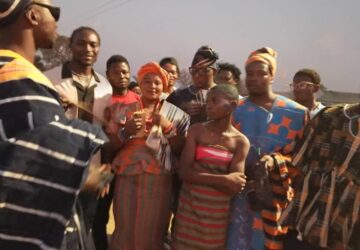
The 2025 Eluo Festival Celebration climaxed in the Sefwi Anwhiaso traditional area in the Western North region, becoming a centre of attraction amidst beautiful displays of beautiful culture and tradition.
Nana Kwabena Gyamfi Akwabeng I (Abontendomhene of Sefwi Anwhiaso Traditional Area) spiced up the beautiful event with a skilful display of dancing in his palanquin.
The reverend chief was mobbed by patrons, while others joined him to the display of beautiful dancing skills.
A few screenshot shots of Nana Kwabena Gyamfi Akwabeng I is attached below;
Nana Kwabena Gyamfi Akwabeng I displaying his dancing skills
Ashanti Regional Chairperson of the Ghana Journalists Association (GJA), Kofi Adu Domfeh, has emphasised the crucial role of responsible media in driving national development.
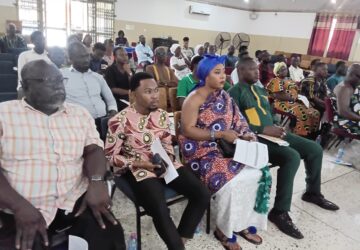
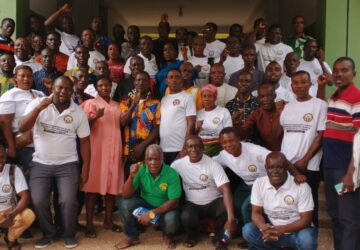
A section of the grandaunts
Speaking at the 6th congregation and matriculation of the OTEC School of Journalism and Communication Studies, Mr Domfeh stressed that a responsible media is the foundational infrastructure for progress.”The media is the catalyst that makes these outcomes possible. Where information flows freely and responsibly, development follows. Where truth is upheld, societies progress.
Mr.Kofi Adu Donfeh speaking at the ceremony
Where journalists are guided by ethics, citizens trust the institutions that serve them,” he noted.Mr Domfeh urged journalists to prioritise fact-checking, verification, and public interest journalism, noting that credibility is the most valuable asset for any journalist.
He also emphasised the need for journalists to protect their well-being, prioritising safety, mental health, and personal integrity.”Responsible media also means responsible journalists — men and women who prioritise their safety, mental health, and personal integrity.
You cannot give your best to society when you are overwhelmed, unsupported, or burnt out,” he said.Mr Domfeh commended the OTEC School of Journalism and Communication Studies for its commitment to academic excellence and practical training, saying the nation needs strong communication institutions to drive development.
The GJA chairman urged the graduating class to serve the public good with integrity and courage, influencing the national narrative and shaping the future.
He also encouraged the matriculating students to approach their training with discipline, curiosity, and humility, building a strong foundation for their future practice.
The event, held on the school premises, brought together a representative of the former Education Minister and MP for Bosomtwe, Dr Yaw Osei Adutwum; dignitaries from OTEC FM; parents; guardians; current students; and the new batch of graduands and matriculants.
A total of 45 students graduated for the 2024/2025 academic year and were awarded certificates of Diploma in Communication Studies at the ceremony in Kumasi.Seventy-six new students also matriculated, starting a two-year journey through the four walls of the esteemed Journalism Institution.
The principal for the school, Mathew Donkor, during his address, indicated that the school offers a two-year diploma in journalism and media studies affiliated with the Commission for Technical and Vocational Education and Training. He emphasised the school has fully obtained accreditation status, making it one of the best destinations for the training of journalists.Source: Emmanuel Bright Quaicoe
The Kumasi High Court has, in a landmark ruling, recognised both Odo Broni (Priscilla Ofori Atta) and Akosua Serwaa Fosuh as valid spouses of the late Ghanaian highlife legend Daddy Lumba.
The decision ends months of fierce legal and public debate over who should perform the musician’s widowhood rites, who controls his estate, and who rightfully bears the title of “widow”.This means both of them can perform the widowhood rites.
While the reasoning for the full ruling is yet to be made available, it is the view of the court that Akosua Serwaa did not provide original marriage certificates of the supposed civil marriage between Daddy Lumba and the plaintiff.
Evidence before the court was extracts and not a true, certified marriage certificate. This ruling, is expected to pave way for the late music icon’s funeral to take place.
Background to the Case
After the death of Daddy Lumba on 26 July 2025, a bitter dispute erupted between two women who claim to be his rightful spouse.

Graphic Online
Akosua Serwaa Fosuh filed a suit on 3 October 2025, asking the court to declare her as the only surviving lawful spouse — a claim based on a civil marriage she said she contracted with the musician in Bornheim, Germany in 2004.
She also sought to restrain the head of the musician’s extended family, Kofi Owusu Fosu, and Odo Broni from claiming any right to funeral and widowhood rites.
The defendants opposed the claim, arguing that under customary practice, Serwaa’s marriage had been dissolved when she allegedly “returned the head drinks” to the family — a traditional act recognising separation — and that Odo Broni, who lived with Daddy Lumba for over 15 years and bore him six children, was the rightful widow.
What Happened in Court
On 25 November 2025, the court was presented with the supposed original civil-marriage documents from Germany — including notary-certified translations and associated paperwork — supporting Akosua
The defence challenged these documents, citing inconsistencies in font styles and notary signatures, arguing the evidence was submitted “at the eleventh hour.”
The presiding judge, Dorinda Smith Arthur, noted that under Ghanaian family law, simultaneous customary and civil marriages are redundant, as each is independently valid. This observation, made during the hearing, effectively opened the door to recognising multiple marital claims simultaneously.
With cross-examinations completed, the court reserved judgment. On the verdict day, it ruled that both women are to be recognised as spouses of Daddy Lumba, entitling them to certain marital rights and recognising their status in relation to funeral, estate and widowhood rites.Source: Myjoyonline