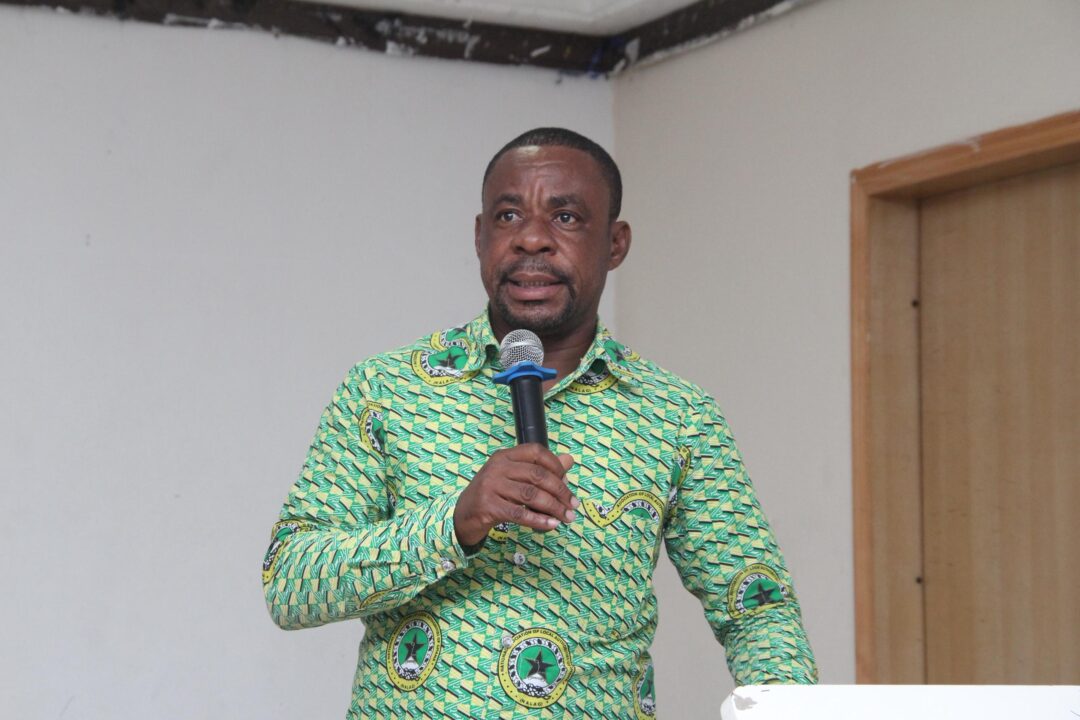
The National First Vice-President of the National Association of Local Authorities of Ghana (NALAG), who is also the Dean of Conference of Presiding Members of Ashanti Region, Mr. Patrick Kwame Frimpong, has made an urgent appeal to the government to reconsider the construction of 24-hour economy markets in every district since they are likely to be abandoned by traders.
According to him, there are already some uncompleted markets in many parts of the country, such as the Kumasi Central Market Phase II, Krofrom Market and Mampongteng Market.
He continued, “Unfortunately, in the Ashanti Region alone, a number of markets have been completed but traders are not using them, making them virtually empty. These markets include the Adoato-Adumanu Market, Patasi Market, Abinkyi Market, Kwadaso Estate Market, Asafo Market, Kropo Market and Asawase Market.”


Speaking to “The New Trust” newspaper on Tuesday, 1st September 2026, Mr Frimpong, who is also the Presiding Member for the Kumasi Metropolitan Assembly, bemoaned the lack of proper consultations with the appropriate stakeholders before the ongoing construction of the 24-hour markets in various Metropolitan, Municipal and District Assemblies (MMDAs) across the country.

Mr,Patrick Kwame Frimpong
According to him, it shouldn’t be compulsory for every district to own or have a 24-hour market, pointing out that there are districts that do not need markets because markets don’t provide inevitable services like health facilities and schools.

He indicated that many traders already prefer selling by the roadside despite available spaces in several markets. “I can tell you that if care is not taken, the markets will be completed but will not function,” he stressed.

Mr. Frimpong said residents of Kumasi and for that matter the Ashanti Region are known for trading, but many markets have been abandoned by traders who, despite the efforts to get them to patronise the markets, are still on the streets selling.
“These 24-hour markets may be completed, but I’m afraid the traders will abandon them…making them a white elephant,” he added.
According to him, the 24-hour economy is a potentially transformative initiative, but its success will depend on proper planning, consultations, financing, infrastructure, and consideration of local economic realities.
The NALAG vice-president said our immediate priority should not be limited to building and operating uniformly designed markets in all the MMDAs to satisfy a campaign promise of a 24-hour economy.
“We should rather ensure that markets are economically viable, safe, accessible, clean, well managed and capable of generating sustainable economic benefits,” he emphasised.
He, therefore, urged the government to reconsider a blanket directive and work closely with MMDAs, traders, and other stakeholders to develop a flexible and sustainable implementation framework.
Mr. Frimpong said, “The central message is, Ghana’s markets must not only operate for 24 hours; they must create value for 24 hours. This approach will help protect public investment, improve the utilisation of existing market infrastructure, reduce waste, and ensure that the 24-hour economy delivers meaningful benefits to communities and local businesses.”
He explained that as a local government practitioner, his position is not a rejection of the government’s 24-hour economy policy. Rather, it is a call for the 24-hour market component to be reviewed, localised,and implemented according to the circumstances of each district.
He also admitted that the 24-hour economy policy has the potential to create jobs, expand economic opportunities, and increase productivity. However, a uniform directive requiring all markets to be built in a single design and operate 24 hours may not be practical or economically sustainable in every locality. By:Isaac Amoah